


Since 2022, majority of the seafood consumed around the world was farm-raised instead of captured at sea, a reality that has actually been applauded as proof that fish farming can satisfy a growing need for seafood while slowing the collapse of the oceans.
The unchecked accept of aquaculture as a sustainable response to feeding the world overlooks some extremely genuine expenses.
The most popular kinds of farmed seafood– salmon, shrimp, trout, seabass, seabream– are fed “fishmeal,” a protein-rich powder or pellet made from the type of wild fish that aquaculture is believed to conserve.
Fishmeal is fed to two-thirds of international farmed fish. Before they reach market, some farm-raised salmon consume more than 6 times their weight in wild-caught fish.
With countless fish farms worldwide, aquaculture supplies countless individuals with year-round access to economical protein. Fish farming is likewise an important source of tasks, particularly for ladies in India.
A far-flung examination by The Outlaw Ocean Project, a not-for-profit wire service based in Washington, D.C., has actually discovered that the aquaculture market’s response to fret about the world’s oceans– “grow more fish so we can capture less”– is typically making the extremely issue it intended to fix even worse and hurting individuals it was suggested to assist.
An employee drives a tractor past mounds of dried and squashed menhaden fish, to be utilized as animal feed supplements, at the Omega Protein processing plant in Reedville, Va., in 2015.
( Andrew Caballero-Reynolds/ AFP through Getty Images )
The examination
Business of fishmeal– frequently out of public view– can include utilizing required labor, poisoning neighborhoods, and removing the incomes of regional anglers.
Fishmeal production has actually caused persistent chemical direct exposure, violent demonstrations– normally stimulated by the stink from fishmeal factories– and intensifying multinational stress as nations complete for catch. That rate is paid mainly by the poorer nations where the primary active ingredient of fishmeal is collected and processed.
The Outlaw Ocean Project mapped approximately the whole worldwide fishmeal market, consisting of more than 1,400 fishmeal factories throughout 64 nations. The effort included lots of reporters from over 15 nations who checked out factories and farms and boarded fishmeal ships at sea.
Utilizing accreditation files, ownership records, trade information, audits and federal government lists of certified fishing ships, the reporting group had the ability to link ships to the plants they provided and select which types were being targeted for fishmeal. This enabled them to figure out which fishmeal plants were linked to ships participated in unlawful or unsustainable fishing. They traced the fishmeal to the fish farm and to where the seafood was offered by sellers.
The examination discovered that more than 2,400 ships connected to fishmeal production, running in the waters of a minimum of 30 nations. It discovered that the majority of those ships do not completely adhere to the Global Charter for Fisheries Transparency, a guide produced by leading ocean-focused civil society groups detailing responsibility requirements for commercial fishing fleets.
Less than 30% of the fleets had openly offered place info, and less than 25% had a distinct vessel recognition number. Such opacity makes the ships tough to authorities.
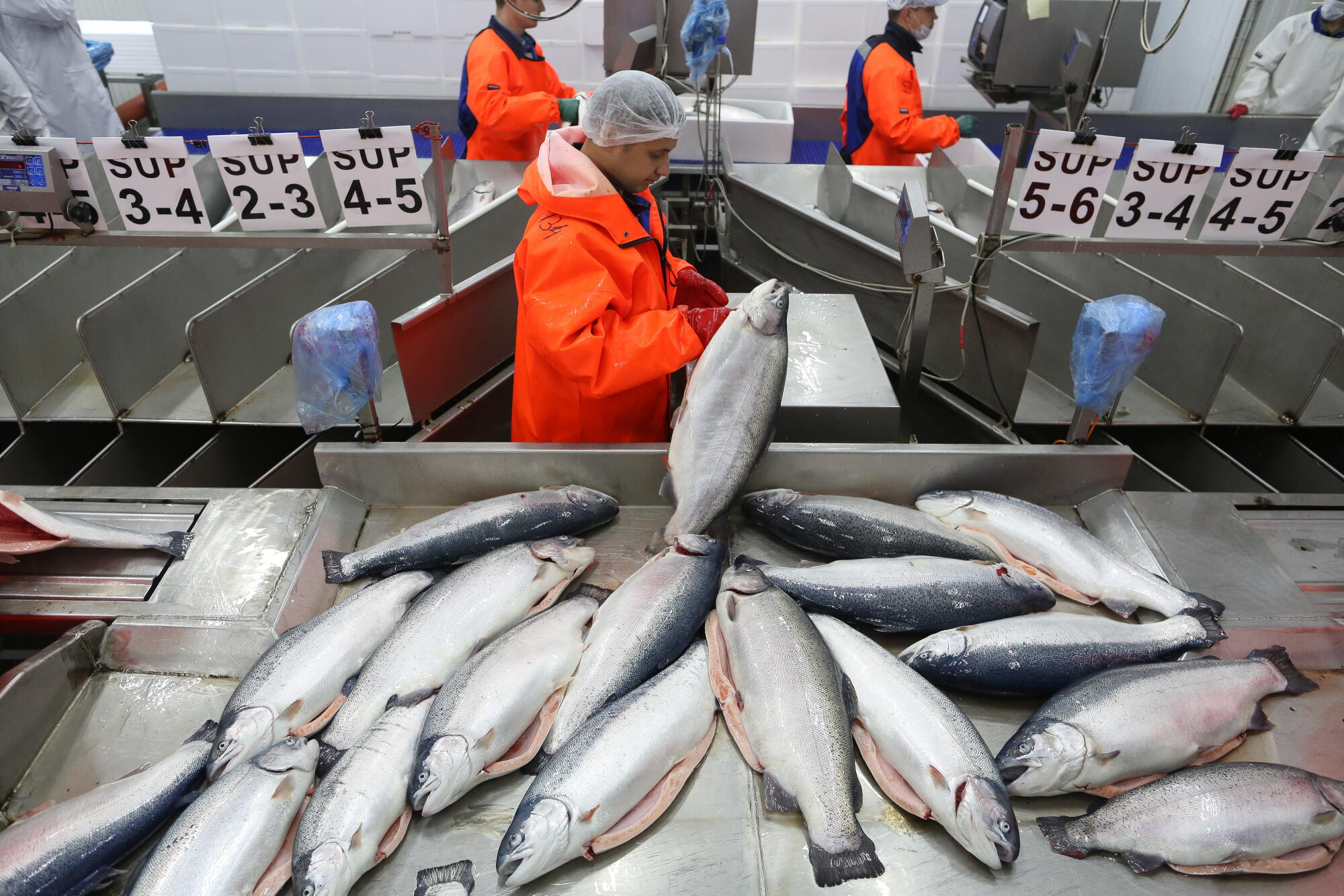
Employees arrange rainbow trout by weight at a fish processing plant in Murmansk, Russia, in 2019.
( Andrey Rudakov/ Bloomberg by means of Getty Images)
A minimum of half of the types landed by the examined fishmeal vessels are categorized by clinical research studies as” overexploited” or even worse. The majority of these vessels are bag seiners or trawlers, which release large webs to record thick schools of fish. Both equipment types are related to high levels of waste, consistently taking big volumes of non-target types.
A minimum of 165 of the ships were bottom trawlers, an especially damaging type of fishing that utilizes weighted webs that scrape the ocean flooring, ruining essentially whatever in their course.
Issues about aquaculture extend far beyond the fate of the oceans. In Gambia and Mauritania in western Africa, the market drives food insecurity as fish that as soon as sustained regional neighborhoods are diverted into fishmeal factories.
In remote islands in Russia’s far east and in China’s Xinjiang area, the reporting detailed making use of required labor on ships, farms and in factories. In other nations, consisting of India and Peruthis market was connected to a minimum of 80 events of civil discontent, some violent, normally in the kind of labor strikes and demonstrations triggered by the water contamination or the stink from factories cooking lots of breaking down fish.
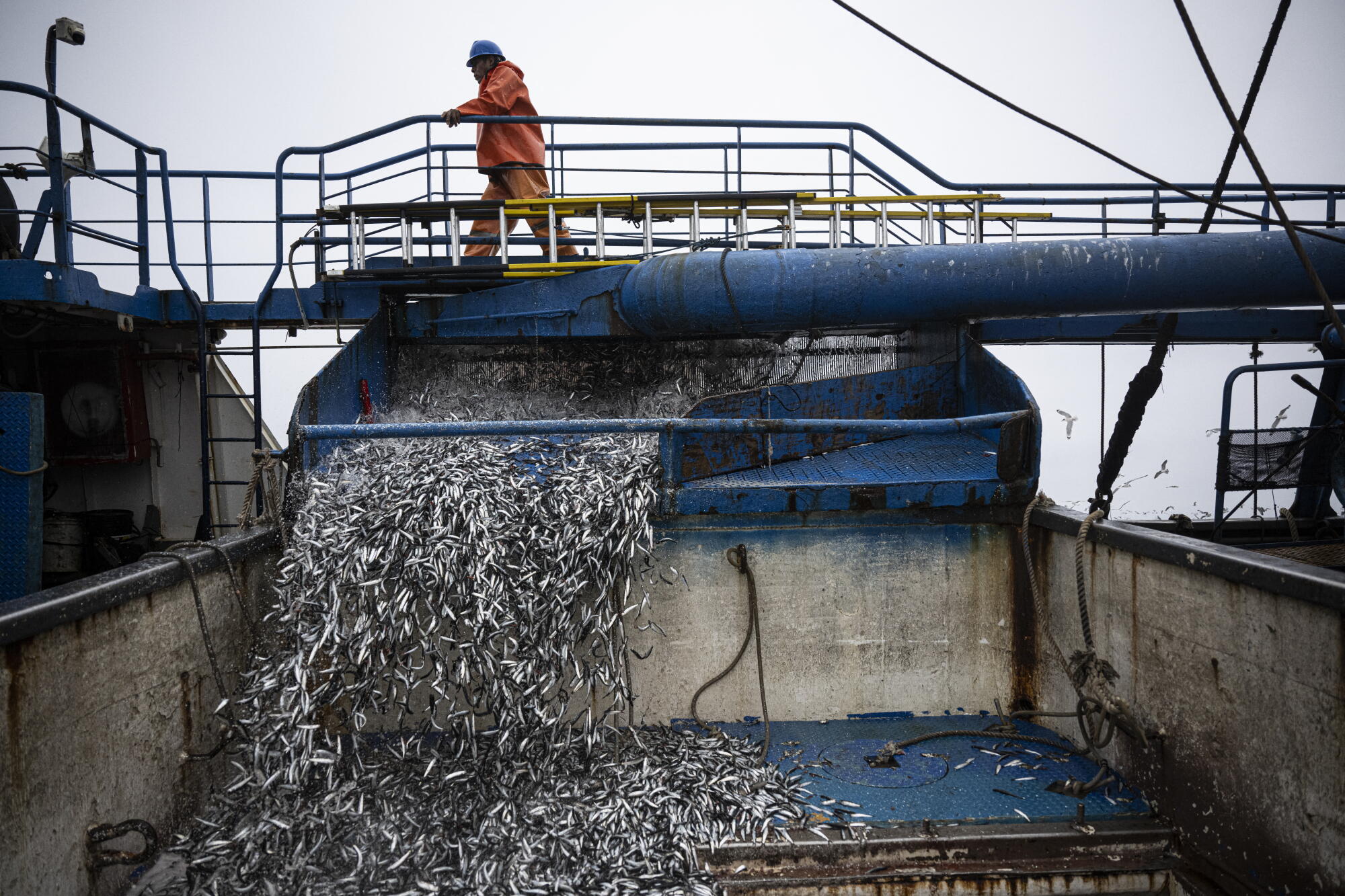
Anchovies are gathered about 5 miles off the coast of Peru’s Lima province on Nov. 19, 2023. Peru is a leading manufacturer of fishmeal and fish oil.
( Ernesto Benavides/ AFP through Getty Images)
InChile in 2024, a number of hundred demonstrators burned tires and obstructed seaside highways and train tracks to object the early closure of the fishing season, a relocation partially driven by overfishing connected to fishmeal.
InSenegalfishmeal has actually put regional fishers out of work, so they significantly are offering– or repurposing– their boats to shuttle migrants to Spain’s Canary Islands, a stepping stone to Europe. This treacherous journey of approximately 930 miles declared more than 3,000 lives in 2025.
“We’re anglers, however there’s no fish left here, so we left,” stated Cheikhou Omar, a 21-year-old angler in 2024 as he rested on a beach in Senegal, saved after the fishing boat he attempted to cruise to Spain capsized, eliminating 30.
The fishmeal market likewise adds to global stress. In 2021, a lots Turkish bottom trawlers fishing unlawfully in the Aegean Sea attempted to ram a Greek research study vessel when the researchers started shooting their activity.
In 2018, riots broke out in Saint-Louis, Senegal, after a fisher was shot and eliminated by Mauritanian coast guards, throughout what the Mauritanians stated was a cross-border raid by a fishmeal boat.
The politics of protein
In her 2021 book “The Fishmeal Revolution,” Kristin A. Wintersteen traces how the Humboldt Current– a cold, nutrient-rich upwelling system along the Pacific coast of South America– was reimagined as a protein mine. That shift, she argues, turned Peru into a fishmeal superpower, accountable for approximately a quarter of around the world production.
Fishmeal assisted sustain the post-World War II growth of commercial chicken and hog farming, especially in Europe and the United States. Ever since, this design has actually spread out worldwide.
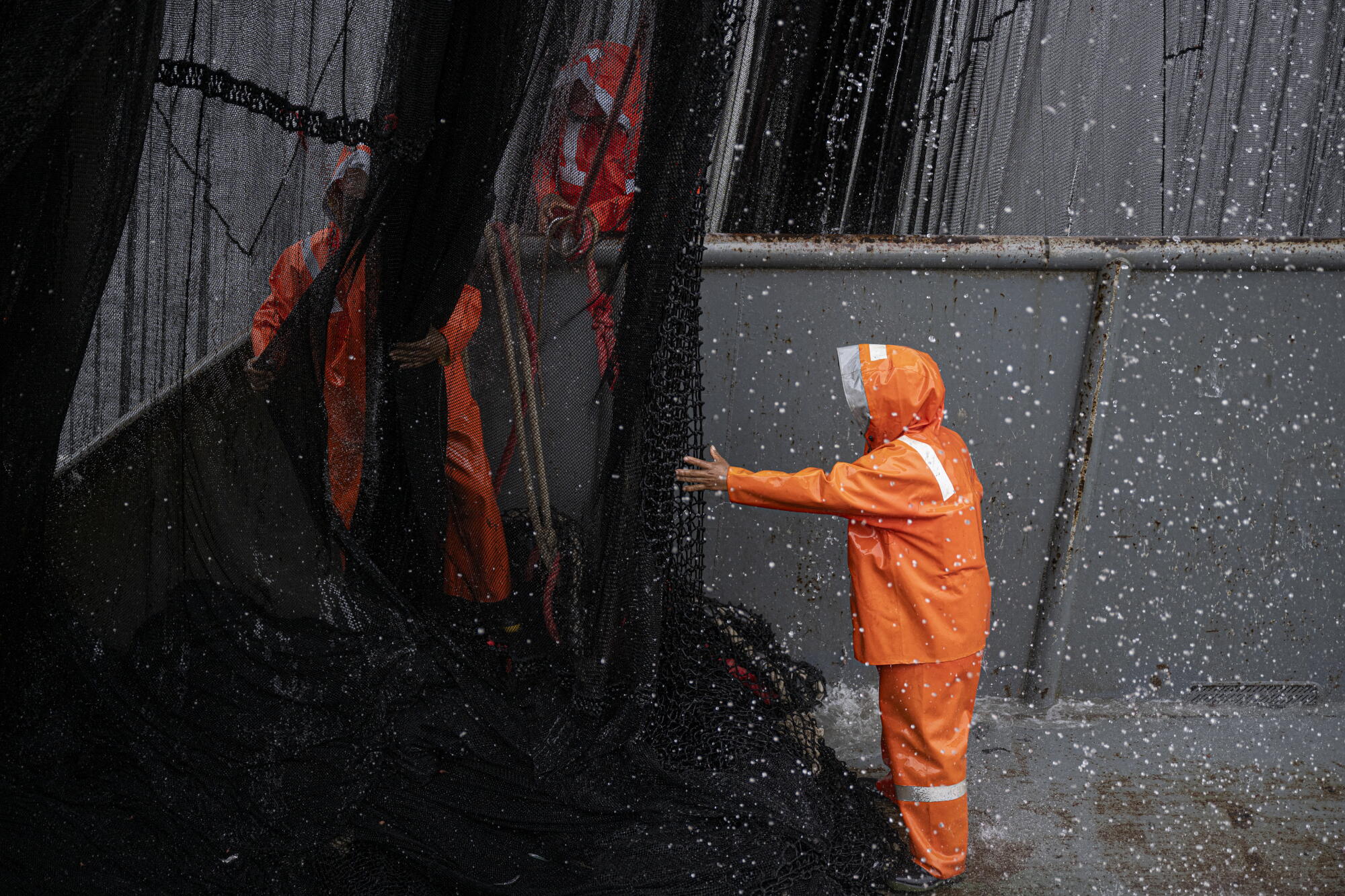
Team members deal with an anchovy boat about 5 miles off the coast of the Peru’s Lima province on Nov. 19, 2023.
(Ernesto Benavides/ AFP by means of Getty Images)
The feed market has actually highlighted that it is reducing its dependence on fishmeal and fish oil– and specifically using entire fish or fish parts that can be consumed by individuals. As aquaculture grows, worldwide fishmeal production is anticipated to increase by almost 10 %by 2032, according to the Food and Agriculture Organization, a United Nations firm.
5 of the world’s biggest salmon business increased their usage of fishmeal and fish oil made from entire wild fish by as much as 39 %in between 2020 and 2024, according to a report from the Farm Animal Investment Risk and Return Initiative.
Inquired about sustainability issues connected to her market, Véronique Jamin, a representative for IFFOthe global fishmeal association, stated that fish farming is “the most effective animal protein system.” She included that her company’s “function is not to encourage which markets must utilize fishmeal and fish oil.” Efforts to make the market more sustainable should think about market forces, she stated, and seafood business need to react to “what individuals really wish to purchase and consume.”
Efforts to move far from fishmeal and fish oil have actually struggled. Scientists have actually determined possible options– consisting of seaweed, cassava waste, single-cell proteins produced by fungis and even sewage.
None are being produced cost effectively at scale, and the options frequently do not have the nutrients that support the development of farmed fish.
The function of required labor
For those toiling at fishmeal plants and fish farms, the work and conditions can be harsh, the examination discovered.
In Russiafish processing employees were cooped in remote business towns or stuck on ships far from coast. “People have no place to go, no cash,” one employee informed President Vladimir Putin, who took part in a call-in tv reveal about the fishmeal plant in 2016. A 2nd employee pleaded: “Please, assist us.”
In China, the aquaculture market is broadening quickly in the nation’s mountainous and desert locations inland, especially in Tibet and Xinjiang, 2 locations understood for political repression, with criminal charges for speaking native languages or practicing spiritual or cultural customs.
Since the U.S. federal government discovered human rights abuses to be prevalent there, Congress enacted a law in 2021 that prohibited all products produced “completely or in part” by employees in Xinjiang or by ethnic minorities from the area on the anticipation that they were made with state-sponsored required labor. No such law exists for Tibet.
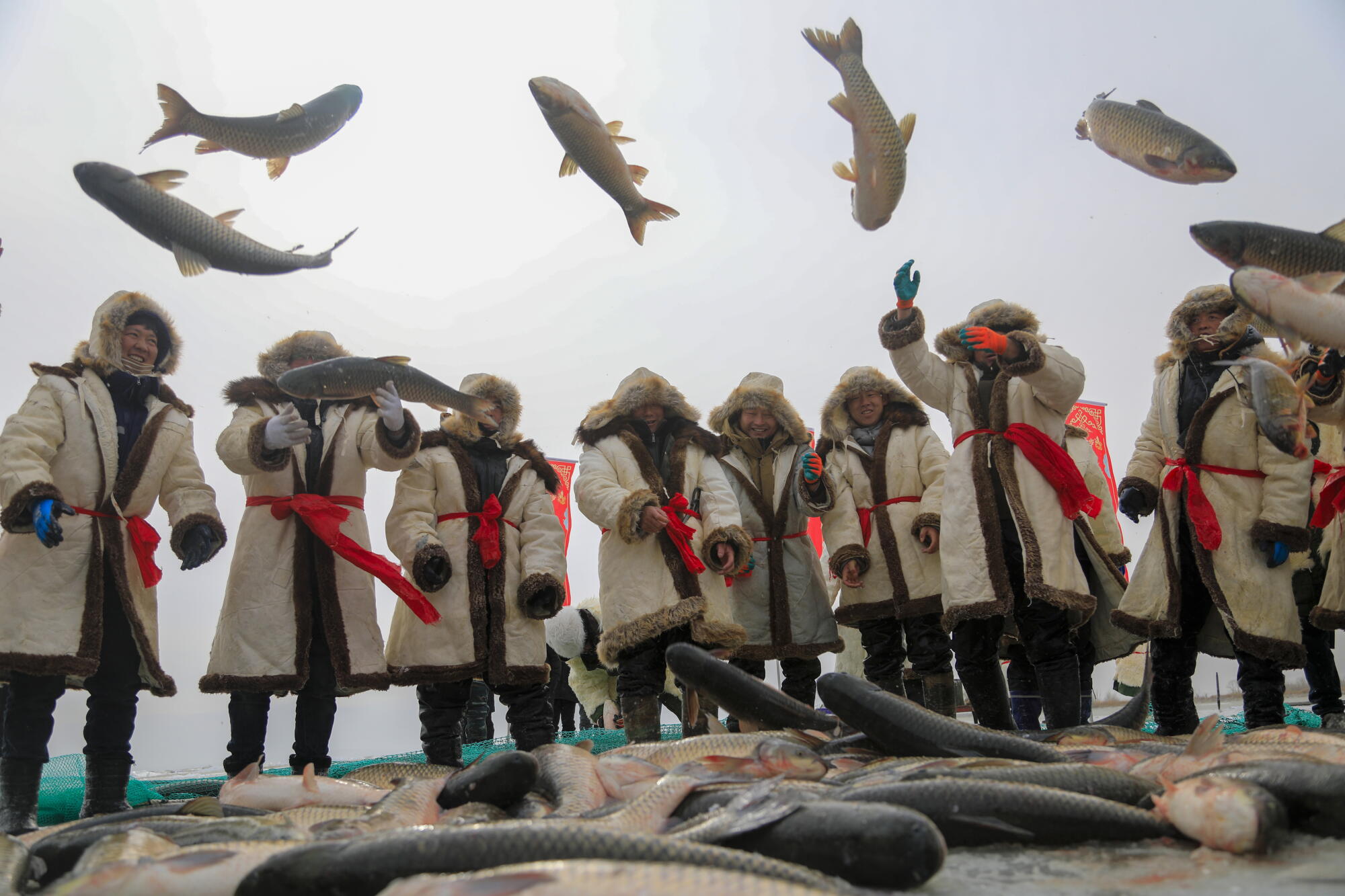
Anglers pull an internet of fish captured from ice-covered Bosten Lake Jan. 18 in the Xinjiang Uyghur Autonomous Region of China.
( Nian Lei/ VCG by means of Getty Images )
The examination mapped more than 1,000 fish farms in Xinjiang and Tibet that produce an approximated half-billion dollars ‘worth of seafood yearly, much of it exported to more than a lots nations, consisting of the United States. Regardless of the 2021 law prohibiting items from Xinjiang, the examination discovered that farm-raised fish from that area have actually reached the United States
The Xinjiang Tiayun fish farm, which produces 40% of China’s locally produced salmon, is connected through supply contracts to a brand name of seafood called Aqua Star offered by Walmart and the world’s biggest food service business, Sysco, which in the U.S. disperses to public schools, military bases and congressional lunchrooms.
Sysco stated it was uninformed of the link to Xinjiang. “We hold all providers throughout our international supply chain liable” to support U.S., global and regional laws, and Sysco suspends agreements when they do not, stated Ramit Plushnick-Masti, a business representative. Aqua Star and Walmart did not react to a demand for remark.
Xinjiang Tianyun stated in a declaration that claims of required labor “are totally factually unproven.” The Chinese federal government did not react to a demand for remark
More than 80% of seafood consumed in the U.S. is imported, and 9% of that originates from China.
Another significant provider of seafood to the U.S. is India, which produces approximately a 3rd of the shrimp that Americans take in, practically all of it grown with fishmeal. The examination discovered a minimum of 18 circumstances of civil discontent and a minimum of 20 cases of water or air contamination connected to Indian fishmeal plants.
In November 2020, Indian federal government private investigators discovered concealed bore holes where the operator of the United Marine Products fishmeal plant in Goa had actually been discreetly getting rid of harmful waste, therefore polluting groundwater. The plant owner rejected misbehavior.
Shrimp offered by Sysco and at Kroger and Safeway is fed fishmeal from United Marine, according to Bait to Platean online tool that maps seafood supply chains. Kroger and Safeway’s moms and dad business, Albertsonsdid not react to an ask for remark.
Sustainable practices
Issues with fish farming have actually occurred worldwide, for some nations, it aquaculture has actually been an advantage.

A bird’s-eye view reveals employees spreading out and drying little fish on conventional bamboo racks under the sun in Bangladesh on Sept. 4.
(Muhammad Amdad Hossain/ NurPhoto through Getty Images)
In Bangladesh, aquaculture has actually driven down the rate of fish. Even accounting for fishmeal and transport to the U.S., the production of specific farmed fish, consisting of tilapia and Atlantic salmon, gives off less greenhouse gas per pound than beef or pork.
Collecting bivalves, like clams, oysters, scallops and mussels, is specifically sustainable due to the fact that these types do not need feed. This kind of aquaculture likewise has a low carbon footprint and the shells work as a kind of carbon capture, according to a 2020 paper by the clinical journal Nature Food.
In the United States, a minimum of 16 factories processed fishmeal since 2025, along the Chesapeake Bay in Virginia, the Gulf Coast in Mississippi and Louisiana, and in California, Oregon and Alaska.
The majority of these factories utilize inedible offcuts from fishing due to the fact that almost every U.S. state has actually banned the targeting of entire fish for fishmeal. The factories likewise tend to be much better managed than plants somewhere else on the planet.
Long supply chains
As the production of seafood has actually ended up being more globalized, its supply chains have actually extended longer, making it harder for customers and grocers to understand whether it was collected sustainably or lawfully.
Robert K. Stumberg, teacher at Georgetown Law and supply-chain professional, stated grocers usually purchase from wholesalers and seldom track their providers. Another factor might be possible deniability, he included. “Companies can get away blame or the requirement to repair issues if they’re uninformed of them.”
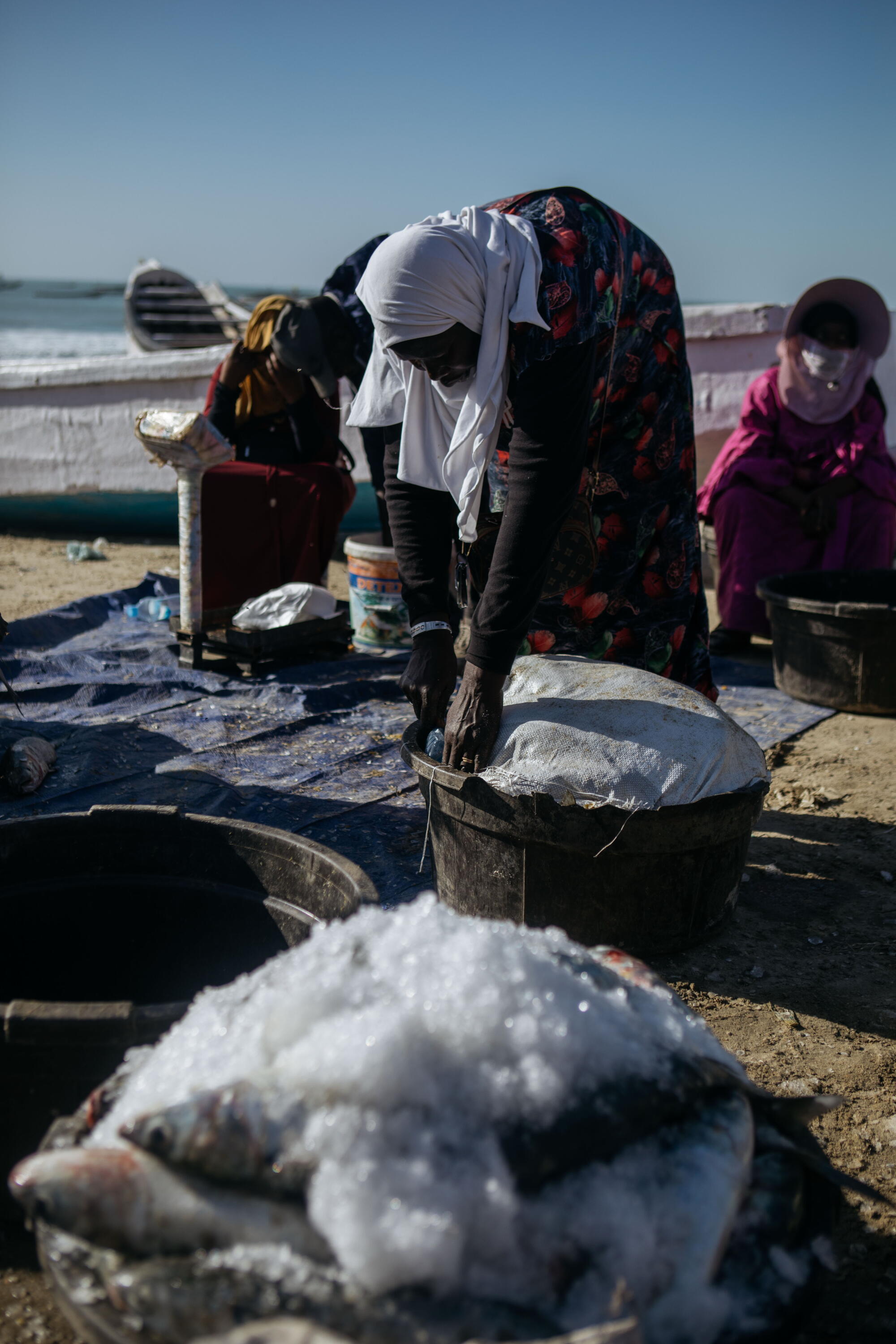
A females offers fish in Port de Pêche, a port in Nouakchott, the capital of Mauritania, on Feb. 7.
(KC Cheng)
With federal government oversight of supply chains in some cases doing not have, industry-led accreditation programs have actually looked for to fill the space and root out unsustainable, dishonest or unlawful practices.
Critics state these programs normally focus on ecological criminal activities and ignore labor abuses on ships. On land, at processing plants or farms, accreditation programs hardly ever perform real check to verify the peace of minds provided by supervisors, stated Allie Brudney, a senior personnel lawyer at Corporate Accountability Lab, a tactical lawsuits not-for-profit.
Rather, the programs regularly notify business before inspectors appear. At sea, these programs typically count on self-reported info from ship captains instead of having auditors check vessels offshore.
Devan Meserve, a representative for the Global Seafood Alliance, which runs the very best Aquaculture Practices program, protected the worth of such assessment programs. She stated that her company represents the “most extensive program for farmed seafood,” partially due to the fact that it covers the “whole aquaculture production chain.”
Securing employees on the fishing vessels that provide feed mills is, nevertheless, an “enormous obstacle,” Meserve included, since audits happen at port. She included that her company assists the market counter unlawful and overfishing by needing feed mills to source the majority of the fish they utilize in fishmeal or fish oil from fisheries certified by accreditation programs like Marine Trust and Marine Stewardship Council.
The danger of incorrect marketing
“Any accounting of the real effect of aquaculture needs to begin not with the farm, however with the feed,” stated Daniel Pauly, job director of the Sea Around United States effort at the University of British Columbia. “And that sort of accounting provides a really various image than the market uses.”
Considering that 2020, a minimum of 9 suits declaring incorrect marketing have actually been brought versus 6 seafood business in 6 U.S. states. Complainants challenged language such as “sustainable,” “environment-friendly” and “wild-caught,” in addition to claims of remarkable worker-safety requirements. 5 of the claims led to settlements, and the business paid the complainants more than $2 million.
Sahrawi anglers unload a fresh catch at the Port of Laayoune in occupied Western Sahara on Nov. 2, 2022.
(KC Cheng)
In a minimum of 4 cases, using fishmeal or fish oil and their link to commercial fishing and community exhaustion were main to arguments that the items were not ecologically sustainable. Extra claims consisted of required labor on fishing vessels and dependence on hazardous pesticides and prescription antibiotics.
The Outlaw Ocean examination evaluated more than 500 seafood business that made marketing claims that were similar to– or more powerful than– those mentioned in the claims. Over half of those business had supply chain ties to fishmeal manufacturers associated with criminal activities, misbehavior and unsustainable fishing practices.
Dana Cleaveley, a research study expert previously with SeaChoice, a Canadian sustainable-seafood group, stated that numerous markets have actually currently needed to start considering the human rights and ecological abuses buried in their supply chains. She mentioned “sweatshop garments,” “fair-trade coffee” and “blood diamonds” as examples.
Seafood has actually been slower to deal with such examination, however, as the world leans even more into aquaculture, that might alter, she stated, especially if more federal governments start limiting imports connected to illegality or unsustainable practices. She included: “That’s when financiers will start to see product, not simply reputational threat, and business will need to change.”
In some quarters, the uncomfortable expenses of fish farming stay unaddressed.
In April 2025, President Trump signed Executive Order 14276, “Restoring American Seafood Competitiveness,” which advised federal government authorities to minimize regulative problems and enhance the business fishing and aquaculture sectors in the United States.
It made no reference of feed or fishmeal.
Urbina is managing editor of the Outlaw Ocean Project. The reporting for this story became part of a bigger examination performed by a global group of reporters based at the Outlaw Ocean Project.
More to Read
Discover more from PMN S.P.O.R.T.S - A PRIME MEDIA NETWORK BRAND
Subscribe to get the latest posts sent to your email.







