


BEIRUT– This wasn’t the method the story was expected to choose Saudi Arabia. In the last few years, headings about the nation concentrated on the scale of its aspiration, or the fantastical giga-projects girding Vision 2030, the full-steam-ahead drive to remake the kingdom into a service and home entertainment powerhouse.
All that was overthrown Saturday, when a Houthi rocket lanced through Terminal 3 of the capital’s global airport, eliminating 13 individuals, consisting of a U.S. nationwide, and injuring more than 300 others.
The attack– the most dangerous Saudi Arabia has actually sustained in years– materialized a war that for a lot of Saudis had actually stayed notional.
It likewise laid bare the bunch of bad situations dealing with Saudi leaders as they compete with a significantly powerful opponent that, unlike them, has little to lose.
That the Houthis have the ability to score hits from 500 miles away, regardless of the Saudi military costs 10s of billions of dollars on multi-layered air defense systems, has actually puzzled specialists.
“To me it’s stunning. Yes, the Houthis have actually improved, however it’s not a matter of them utilizing a brand-new weapons system,” stated Wolf-Christian Paes, an associate fellow at the London-based International Institute for Strategic Studies.
“The issue needs to be on the Saudi side,” Paes stated. “Something needs to have gone terribly incorrect and continues to go terribly incorrect.”
Videos on social networks Saturday revealed guests treking gradually in a security line before the rocket hit, sending them running through the smoke-filled terminal, pieces of particles drizzling around them.
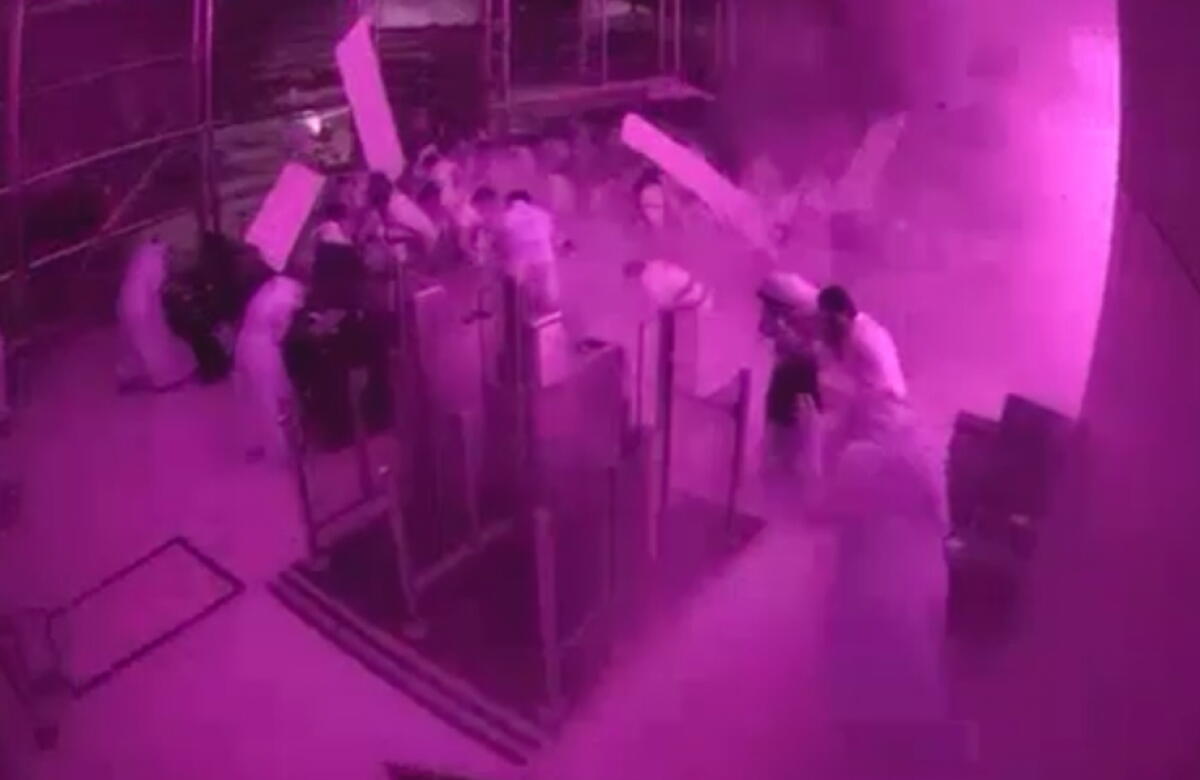
Guests hide as flames and smoke fill part of King Khalid International Airport in Riyadh, Saudi Arabia, throughout a rocket strike on Oct. 10, in an image from CCTV launched by the Saudi media ministry.
( Saudi Media Ministry through Associated Press)
Riyadh’s King Khalid International Airport was shuttered after the attack– more than 99%of flights were canceled, according to the air travel analytics firm Cirium– the Houthis struck another terminal structure Sunday, eliminating one individual.
On Monday, air travel authorities extended the airport’s closure. Other airports throughout the kingdom were likewise targeted, in addition to gas centers and oil refineries, the Houthis stated.
Yahya Saree, the Houthis’ military representative, on Sunday cautioned airline companies and tourists to prevent Saudi airports, calling them “risky.”
Numerous Riyadh-based companies informed their workers to work from home, and schools moved to online classes.
On Monday, the U.S. Embassy in Riyadh warned people to keep their range from the airport and surrounding locations.
The timing of the Houthi project appears determined for optimum reputational damage. On Sunday the kingdom started hosting the World Petroleum Congress, an occasion that typically draws oil heavyweights from throughout the world, consisting of energy ministers along with CEOs from BP, Exxon Mobil Corp., Shell and TotalEnergies.
It’s uncertain how numerous were able to go to, with some delegates required to drive hours throughout the desert from Bahrain or Jordan to reach Riyadh. Others, consisting of Italy’s energy minister, participated in a conference by means of video link.
Comparable issues now swirl around the Future Investment Initiative, Saudi Arabia’s flagship organization conference, which is set for completion of the month. Authorities, keeping a show-will-go-on mindset, firmly insist the occasion, referred to as “Davos in the Desert,” will take place on schedule.
In action to the Houthi attacks, Saudi Arabia’s armed force stated it peppered rebel-held locations with more than 120 strikes, consisting of the airport in the Houthi-controlled Yemeni capital, Sanaa.
Those strikes highlight the asymmetry of the battle, professionals state, with Saudi military organizers searching for Houthis in locations currently damaged by dispute, even as they should protect a location more than 5 times the size of California.

Mourners bring the body of Mahmoud al-Barqawi, 33, a Jordanian guy, at his funeral service in Amman, Jordan, on Oct. 12. Al-Barqawi was eliminated in what Saudi authorities stated was a Houthi rocket attack on King Khalid International Airport in Riyadh on Oct. 10.
(Raad Adayleh/ Associated Press)
“Saudi Arabia is a nation of 2 million square kilometers, with a huge variety of soft targets– airports, pipelines, city facilities that requires to be secured, federal government facilities. We’ve seen them all assaulted,” stated Thomas Juneau, a security expert at Ottawa University.
He included that the Saudi military “has actually not identified itself in regards to military efficiency versus the Houthis.”
The Saudi-Houthi dispute dates to 2014, when the Houthis whacked the Yemeni federal government aside and took control of Sanaa before blitzing through other parts of the nation.
The Saudis countered with an air project and ground force made up of Yemeni pro-government paramilitary factions, Saudi and Emirati soldiers and mercenaries.
The outcome was a humanitarian crisis that at the time was thought about the world’s worst, with some 377,000 individuals eliminated, according to the Yemen Data Project, which tracks casualties from Yemen’s numerous disputes. Majority of the deaths was because of the collapse of the health system, together with upsurges and scarcity.
The Houthis, strengthened by years of battling versus the federal government, lost much of the area they took in south Yemen, however otherwise grew more powerful in the war.

Houthi fans bring rifles while going to a tribal rally in Sanaa, Yemen, on Oct. 7.
(Osamah Abdulrahman/ Associated Press)
With training from Iran and the Lebanese faction Hezbollah, they progressed from a mangy band of fighters with shoes and Kalashnikovs to a disciplined force fielding rockets and making its own projectiles. (Recently, Anthropic, the maker of Claude AI, cautioned the Houthis were utilizing its AI designs to program rocket computer systems.)
In 2022, with cutting edges in a stalemate, Saudi Arabia and the Houthis signed a truce that mainly held.
In July, warplanes struck Sanaa airport to avoid an Iranian aircraft with Houthi authorities from landing. The Saudi-backed Yemeni federal government declared obligation, the Houthis blamed Saudi Arabia.
Ever since, the Houthis, whose main name is Ansar Allah or God’s Supporters, have actually rebooted their rocket and drone salvos and revealed a “blockade within a blockade” on Saudi shipping. In September, they routed pro-government fighters and caught Yemen’s Red Sea coast.
Yemen’s federal government recently released an offending to retake the locations under Houthi control, backed by a fresh Saudi battle project.
The restored hostilities come as Saudi Arabia has actually been fighting a financial downturn and rolling back a few of its flashier financial investments.
That financial despair has actually because been intensified by the Iran war. With the Strait of Hormuz mostly sealed by competing U.S and Iranian blockades, Riyadh moved its exports from Hormuz, its primary energy passage, to the Red Sea coast. Houthi advances, nevertheless, now endanger that channel.
One possible factor for the kingdom’s vulnerability is that it got in the fight with the deck stacked versus it.
The Saudi armed force has 108 Patriot rocket launchers and a little number of THAAD rockets, enabling it to obstruct rockets and drones at various elevations and varieties.
Throughout the U.S.-Israeli war on Iran, which saw Tehran lash out with attacks on its Persian Gulf next-door neighbors, Saudi Arabia used up some 86% of its 2,800 rockets, according to reports.
The nearly 400 interceptors that stay are enhanced by a Greek army contingent with a Patriot rocket battery and approximately 100 soldiers. Pakistan and Turkey, Saudi Arabia’s partners in a just recently signed shared defense pact, are likewise fielding their own air defense weapons inside the kingdom. Those are not likely to be enough to safeguard the whole nation, experts state.

Aramco CEO Amin Nasser participates in a conference in Riyadh, Saudi Arabia, on Oct. 11, 2026.
(Baraa Anwer/ Associated Press)
Crown Prince Mohammed bin Salman, the nation’s de facto leader, has actually gotten in touch with the U.S. and other allies to come to his nation’s defense. Authorities at the World Petroleum Congress on Monday echoed his message, with numerous worrying that interrupting Saudi energy products would have effects beyond its borders.
“No country, even one as capable and positive as ours, can protect them alone,” stated Amin Nasser, president of Saudi’s oil giant ARAMCO.
President Trump has actually so far shown unwilling to offer more than intelligence and logistical assistance. On Saturday, after the airport attack, Trump stated he “might” sign up with the Saudis’ project. “We’re going to take a look at it,” he stated.
Even if more robust help were to emerge, the Saudis will still deal with hard options.
The very best choice, Paes stated, would be for Saudi Arabia to discover a brand-new understanding with the Houthis. He acknowledged that the group has political needs– consisting of having Saudi Arabia pay Houthi civil servant wages– that will be hard for Saudi leaders to swallow.
“The offer they’ll leave the Houthis will be a lot even worse than what they might have got a couple of months earlier,” Paes stated.
Still, he included, “that’s the least worst result.”
More to Read
Discover more from PMN S.P.O.R.T.S - A PRIME MEDIA NETWORK BRAND
Subscribe to get the latest posts sent to your email.







