


The general public broadcaster recently exposed a shock $12 million spending plan blowout, which is more than 25 times the $470,000 it had actually anticipated to lose for many years to June.
RNZ chief monetary officer Hilary Parker resigned all of a sudden in early October, and president Paul Thompson – who was because of leave on 31 December – has actually left 6 weeks early.
The organisation has actually commissioned an independent evaluation of what failed and has actually suggested 58 tasks would need to go, which is double the number it had actually indicated in August as a reaction to moneying cuts.
Board chair Brent Impey stated the board and senior supervisors just found out the complete scale of the loss in mid-October.
Jones worried the caretaker federal government was not throughout all the information.
“But know this from me … when you see an enterprise where the cash has gone from $23 million down to $8 million in about two years, the costs have not been trimmed to meet the reduction in revenue, then you have an organisation in decay,” he stated.
“It is just not credible for people of governance merit to have missed such a rapid reduction in cash, and possibly believing that they would make up for the shortfall by selling assets when they know that those assets and the returns are expected by Treasury to come back to the .”
The broadcaster ended June with $8.5 million in money, below $18.8 million a year previously and $23.5 m the year before that.
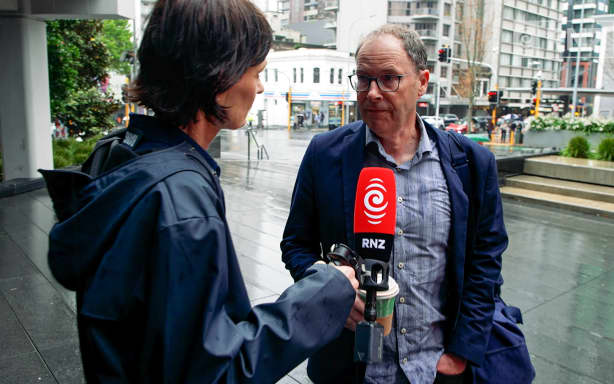
RNZ president Paul Thompson (R) is questioned about the spending plan blowout by Checkpoint host Lisa Owen.
RNZ/ Nick Monro
Jones stated board members were blaming and utilizing “hysterical” language in the media, such as stating the circumstance is incomprehensible.
“Incomprehensible to who? That’s why you have a board, that’s why you have an audit committee,” he stated.
“You put people with experience that you can trust, and I just feel that someone in that organisation has flipped the bird to the taxpayer, and I’m very worried that the right people are held accountable.”
The independent evaluation was insufficient, too late, Jones stated.
“This is a major financial blow to a flagship organisation in New Zealand, and I’m sorry, I’m just not going to tolerate all this theatrical performative nonsense that no one knew what was happening. It’s just not credible.”
Jones stated the next federal government would make choices on the future of the board once it had all the essential info from the independent evaluation RNZ had actually commissioned.
“A future government has to deal with that issue on the basis of facts and on the basis of whether or not the current stewardship is sustainable.”
RNZ did not react particularly to Jones’ criticisms.
In a declaration, a representative stated: “RNZ accepts responsibility as an organisation for this result.”
They stated the independent evaluation would develop what took place, and it would not comment even more while that’s under method.
Talking to Early morning ReportJones stated a lot of individuals on the cutting edge would bear the force of the governance failure.
He stated “even a simpleton” might see RNZ had actually been “bleeding cash” over the last few years.
“It was gag-inducing to listen to the former chair of the Audit Committee mount some sort of rearguard defence. It reminded me of Queen Gertrude from Shakespeare. It’s too much.”
At the end of the day, Jones stated the dollar stopped at the board, and he was questioning the reliability of the board in its claims it wasn’t familiar with the monetary problems.
“There’s going to be a clean out at Radio New Zealand, but it’s taking place at what would appear in the context of panic, in the context of obvious confusion and finger pointing. But you would know as well as I do that someone’s flipped the bird and someone has to pay the price.”
He stated individuals would be worried about their work, and the management procedure was not a proactive one.
He stated the CVs of those on the board “glow” “mate, they’re smudged”
RNZ’s culture required to alter and it earnings track was decreasing while expenses were not handled, Jones stated.
“More importantly, you appoint a board to ensure that those matters are dealt with.”
‘Watershed’ minute for RNZ
Previous broadcasting minister Steve Maharey stated he thought it was time to once again take a look at the nation’s 2 openly owned media organisations, RNZ and TVNZ.
The outlook for RNZ was “grim” and it wasn’t simply RNZ, there was a decrease throughout all media organisation shedding reporters.
Maharey stated all New Zealanders should be taking a look at this and asking if the pattern was sustainable, offered the strong requirement for media in this nation.
With RNZ being openly moneyed, it made it challenging for the organisation to “dig its way out” of its monetary hole – and is reliant on the federal government offering more money.
He stated RNZ had actually not been moneyed well for a long time, and it had actually made it vulnerable.
It was taking the organisation down an unsustainable course, with too couple of reporters who would not have the ability to get the job done effectively.
He stated it was time to believe “through what to do with these two publicly owned organisations that may morph into something stronger and better and well thought through for the future, I think is a good way to move.”
Maharey stated RNZ could not be permitted to “go down the tubes” as public broadcasting was a “must have”
“I think you do need a mixture of media in a country,” he stated.
“If you don’t have a public broadcaster as part of that mix, completely dedicated, independently telling the universal story of how things are going, then we’re going to end up like America with people just sitting in camps and echo chambers talking to each other, never really getting out and hearing other points of view. That’s what a public broadcaster does and it needs to be strong, well-funded with really good journalists doing that job.”
It was a genuine “watershed” minute for RNZ, Maharey stated, and individuals required to pay the cost – however the cost should not be a public broadcaster that can’t do its task
Discover more from PMN S.P.O.R.T.S - A PRIME MEDIA NETWORK BRAND
Subscribe to get the latest posts sent to your email.







