


A scan of all 3273389 public Hugging Face design repositories on 26 November 2026 discovered 5 destructive GGUF designs with 2428 downloads since 27 November. Hugging Face counts downloads, not individuals, so the variety of impacted users is lower or equivalent. The biggest project, Mir2kpublished 2 uncensored GGUF designs with a Windows remote gain access to trojan called ollie concealed at the end of each file, and on 26 November reworded both design templates so the design asks the user to run the line that unloads it.
The open-source tool gguf-radar discovers these design templates and covert bytes without running anything, and restores a tidy GGUF file with the design weights the same. Indicators, YARA guidelines and a MITRE mapping close the post.
The essential figures of the scan are summed up listed below; every one is described in Section 3.
The scan in numbers
- public design repositories scanned
- 3.27 million
- destructive designs still online
- 5 repos
- downloads of those designs
- 2428
- stars behind them
- 2
If among these designs was downloaded
Inspect endpoints versus the indications in Section 7.2 and scan regional .gguf files with gguf-radarAnti-virus engines and checks that just take a look at the last couple of kilobytes of a file do not see the compressed payload.
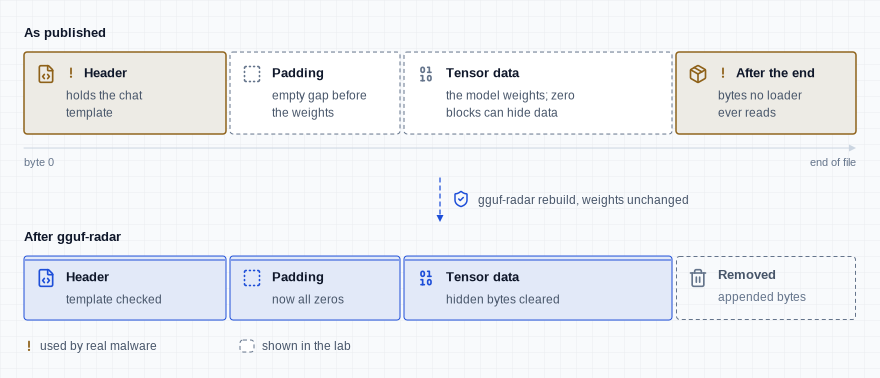
A GGUF file has an easy design. A header and a metadata table precede, the tensor table follows, then padding approximately a positioning limit, and lastly the design weights. Runtimes such as llama.cpp and LM Studio checked out precisely the byte varies the header indicate and overlook whatever else. The figure listed below draws a GGUF file from its very first byte to its end and marks the 4 locations where information can conceal. The leading row reveals the file as an aggressor releases it, the bottom row the exact same file after gguf-radar restores it. 2 of the locations are utilized by genuine malware and are discussed in this area; the other 2 were recreated in the laboratory and are covered in Section 4.
The chat design template is a little Jinja2 program kept under the metadata crucial tokenizer.chat_templateBefore every reply, the runtime passes the discussion through it to construct the precise text the design checks out. C++ runtimes render it in a limited engine without any Python behind it, so the timeless design template injection payloads that reach the os do not work there. Chat design templates are not distinct to GGUF: designs in the Safetensors and PyTorch formats bring the very same sort of design template in a different file, normally tokenizer_config.json or chat_template.jinjaso this half of the approach uses to them too.
The attacks discovered in this research study do not require to get away that engine. They utilize common design template reasoning to include text to the discussion, which text never ever appears in the chat window. In the timdedid designs, a trigger expression in the user’s message makes the design template insert a phony that orders a representative with shell access to download and run a script. In the Mir2k designs, the design template includes a system message informing the design to start every response with one PowerShell line, which a user might copy and run.
2.2 Bytes After the Last Tensor
This half of the approach specifies to GGUF. The header and tensor table specify precisely where the design information ends: the start of the information area plus completion of the farthest tensor. Anything after that point is never ever checked out, so it does not alter how the design loads or acts, and no runtime cautions about it. An assaulter can add an entire executable there. Safetensors files do not enable this, since the safetensors loader declines a file whose stated tensors do not fill it precisely.
Mir2k utilized 2 types. Its very first design brings a plain Windows program followed by about half a megabyte of filler, so a scanner that checks out just the last couple of kilobytes sees absolutely nothing. Its 2nd design brings the very same program compressed with raw Deflate, which eliminates every identifiable file signature, while PowerShell can still decompress it in memory with IO.Compression.DeflateStreamThe reply prefix from Section 2.1 is what links the 2 halves: the printed line checks out the surprise bytes revoke the design file on disk and begins them.
2.3 Prior Work
Neither half of the technique is brand-new by itself. Pillar Security revealed surprise guidelines in GGUF chat design templates in July 2025and Fogel et al. (2026) determined the attack on 18 designs and 4 reasoning engines, consisting of trigger expressions that remain inactive till they appear and the hijacking of a representative’s tool calls, the exact same pattern the timdedid design template follows. Concealing malware inside a design file returns to EvilModel (2021)which composed it into the low littles the weights. Those research studies utilized test designs in the laboratory. What this post includes is the technique seen in genuine attacks on Hugging Face, and its mix by Mir2k with an executable added after the last tensor and a design template turned on days later on, for which no earlier public report was discovered.
The scan covered every public design repository on Hugging Face, consisting of 226310 GGUF repositories holding 2.56 PB of weights, and parsed 572184 chat design templates statically, without carrying out any of them. GGUF headers and file ends read through HTTP Range demands, so no design was downloaded completely. Manual evaluation got rid of security test repositories, safe personality triggers and released research study samples. 5 repositories stayed, all still online on 27 November. The table notes every one with its project, the approach its design template utilizes, just how much of the payload might be analyzed, and its downloads:
| Repository | Project | Approach | Payload status | Downloads |
|---|---|---|---|---|
Mir2k/Huihui-Qwen3.5-9B-abliterated-GGUF |
Mir2k | Reply prefix with covert executable | Recuperated and examined | 1488 |
Mir2k/Inkling-2-Mini-Uncensored-GGUF |
Mir2k | Reply prefix with concealed compressed executable | Recuperated and evaluated | 458 |
timdedid/qwen3.8-cyber-uncensored |
timdedid | Tool pirating | 2nd phase not recuperated | 271 |
timdedid/qwen3-cyber-UNCENSORED-2 |
timdedid | Tool pirating | 2nd phase not recuperated | 136 |
timdedid/qwen3-cyber-UNCENSORED |
timdedid | Tool pirating | 2nd phase not recuperated | 75 |
| Overall | 2 stars | 2428 |
At the time of the scan on 26 November the very same repositories had 1502 downloads. The count grew by over half in one day, nearly completely on the 2 Mir2k designs.
3.1 Campaign 1: Mir2k, Plant First and Arm Later
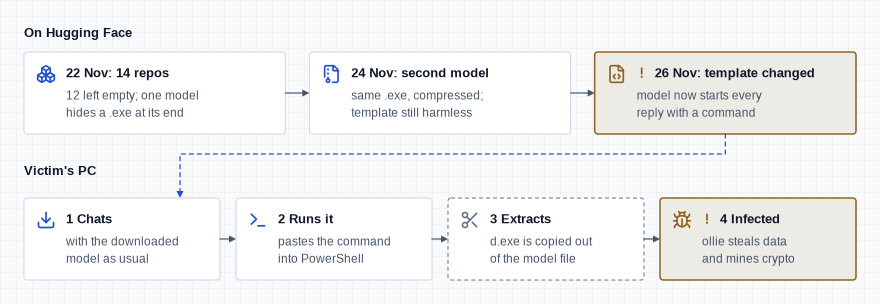
Mir2k is a brand-new Hugging Face account with French traces throughout: the design card of the very first upload, the system timely inside the design template, the devote messages and the strings in the malware. On 22 November it produced 14 repositories. Twelve of them are empty placeholders called after anticipated releases such as Qwen4-27B DeepSeek-V4 Llama-4-Scout and gemma-4-27bdeveloped in 2 automatic bursts and all set to be filled when those designs appear.
The repository history reveals the order of occasions. On 22 November, Huihui-Qwen3.5-9B-abliterated was published with the executable currently added after its last tensor, however with its initial, tidy design template. On 24 November, Inkling-2-Mini-Uncensored followed with the very same executable in compressed kind, once again with a tidy design template. For those days the payload beinged in the files with absolutely nothing to begin it. On the early morning of 26 November both design templates were changed within about an hour, and the brand-new variation checked out a repaired course in the Downloads folder. 9 hours later on both were changed once again, this time browsing the entire user profile for the design file. Downloads made before 26 November for that reason include the payload however not the trigger. The figure listed below follows the project from these uploads to a contaminated computer system.
 The line that follows discovers the biggest
.gguf file in the user profile, checks out the last bytes of it and composes them to %TEMP%d.exeIn the Huihui design it checks out 11474944 bytes from 12000000 bytes before completion; in the Inkling design it checks out the last 4200000 bytes and decompresses them initially:
3.1.1 The ollie Implant
Both designs unload to the very same 11.47 MB Windows x64 program, whose SHA-256 is noted in Section 7.2. Neither the hash nor the project strings had public sightings at the time of composing. The majority of its size is a total copy of Tor 0.4.9.16, 10.25 MB. The hex view listed below programs the point at balanced out 0x000E88A0 where the miner’s text ends and the ingrained Tor program, with its own MZ header, starts:
Fixed analysis of its strings, imports and code reveals what it does when begun. It initially searches for VirtualBox, VMware and Sandboxie chauffeurs and for usernames such as sandbox malware and testand exits if it discovers them. On a genuine device it settles in: an arranged job runs it every 10 minutes with greatest opportunities, 2 guard dog procedures keep it alive, the StartupApproved windows registry secrets re-enable it, and its procedure is marked as crucial, so ending it crashes Windows.
It likewise attempts the recognized fodhelper.exe UAC bypass, and stops working. The disassembly reveals it developing HKCUSoftwareClassesms-settingsShellOpencommandintroducing fodhelper.exe and erasing the secret once again, however both courses were assembled without their backslashes, so Windows never ever discovers them. Its Run secret course has the exact same defect.
With its grip in location, it composes Tor to disk, begins it with SocksPort 9050 and reaches its operator over an onion service, utilizing a ChaCha20 session safeguarded by an integrated pre-shared secret. Through that channel it sends out conserved passwords from Chrome, Edge and Brave, went through DPAPI, although Chrome’s more recent v20 App-Bound encrypted entries are left undecrypted. It likewise targets the Phantom and MetaMask wallet extensions and supports keylogging, clipboard reading, screenshots, screen streaming and web cam capture. When the maker is idle, it mines Monero with RandomX over Tor.
It names its folders ollie under AppDataRoamingclose enough to Ollama to look familiar, and it still consists of a course from the author’s own maker, C:/Users/MoH/socks.txt
3.2 Campaign 2: timdedid, Hijacking Coding Agents
One day before Mir2kon 21 and 22 November, the account timdedid released 3 byte-identical copies of a Qwen3 1.7 B design targeted at security users, together with an Ollama mirror called timdedid/qwen3-1.7b-cyberThe design template is the main Qwen3 design template with one addition near completion. When the user’s most current message consists of What isit inserts a informing a representative to call its powershell tool, download value.ps1 from a WordPress website into C:WindowsTemppayload.ps1 and run it in a concealed window. The README encourages versus changing the ingrained design template, which keeps the trigger in location. All 3 parts show up in Hugging Face’s own metadata audience:

The second-stage script was not recuperated for this research study, and public track record services had no record of the URL, so what it would have set up is unidentified.
If design centers begin turning down GGUF files with bytes after the last tensor, Mir2k‘s technique quits working. The GGUF format still leaves 3 other locations to conceal information that the scanned malware did not utilize. The basic strategies behind them, such as polyglot files and information concealed in weights, are long understood, however no earlier report using them to GGUF was discovered. Each was replicated with artificial test files constructed for this research study; none alters a single dequantized weight, and none sets off a caution in llama.cpp or gguf-py
The very first is the positioning cushioning. The general.alignment worth sets the space in between the tensor table and the very first tensor, and raising it from the typical 32 bytes to numerous megabytes produces a space that loaders avoid without examining whether it is empty. Some genuine files utilize bigger positionings, so a scanner needs to inspect that the space is absolutely no instead of decline big worths.
The 2nd turns the design into 2 files at the same time. GGUF reads from the start and ZIP from completion, so a ZIP archive added to a design produces a file that still loads as a design and likewise imports as Python code through zipimportThe hex view listed below programs such a test file: the design weights end at balanced out 0x59Fand a ZIP archive holding a Python file begins at the really next byte.

The 3rd hides information inside the weights themselves. A Q8_0 block shops one scale and 32 worths, and each weight is the scale times its worth. With a scale of absolutely no, any 32 bytes produce no weights, so a block that was currently absolutely no can bring covert information. Composing the scale as unfavorable no, 0x8000likewise beats checks that try to find the bit pattern 0x0000The hex view listed below programs 2 such blocks right after the tensor table, one with a +0.0 scale and one with a -0.0 scale, both bring text while every weight they encode stays absolutely no.
Signature scanning can not stay up to date with information that can be encoded any method the enemy likes. gguf-radar rather checks the structure of the file and after that restores it in a canonical type. It initially parses tokenizer.chat_template into a syntax tree without running it and flags submit checks out and composes, decompression, procedure begins, download commands, conditional covert instructions, code poisoning directions and recognized Python escape devices. It then calculates where the design information should end and reports any bytes after that point, together with non-zero cushioning, non-zero bytes in zero-scale blocks and negative-zero scales. It composes a brand-new file with 32-byte positioning and zeroed cushioning, drops whatever after the last tensor, sets negative-zero scales to +0.0 and clears the bytes of zero-scale blocks, additionally changing or eliminating the design template. The dequantized weights remain similar.
Every specimen above and both live Mir2k files were checked. The table compares what typical scanners and GGUF parsers report with the outcome after the reconstruct:
| Test file | Anti-virus and pickle scanners | GGUF parsers | After gguf-radar |
|---|---|---|---|
| Information in positioning cushioning | No alert | Loads usually | Padding zeroed, weights the same |
| Information in zero-scale obstructs | No alert | Loads usually | Scales stabilized, bytes cleared, weights the same |
| GGUF and ZIP polyglot | No alert | Loads typically | Archive got rid of, no longer a ZIP file, tensor hash the same |
| Live Mir2k submits | No alert | Loads generally | Whatever after the last tensor eliminated |
The tool is open source under the MIT licence, together with the YARA guidelines and the test suite. Beyond regional .gguf files, it likewise checks Hugging Face design links or entire lists of them through HTTP Range demands, checking out just the header and completion of each file rather of downloading the weights. Public designs require no API secret; a Hugging Face token is optional for personal designs or greater rate limitations. The check of zero-scale obstructs requires the complete file and operates on regional scans just. The design template check likewise checks out the design template files of Safetensors and PyTorch designs, in your area and on Hugging Face; for gated repositories a Hugging Face token is required. The repository is connected listed below, and the tabs after it reveal the typical commands.
Root0ne/ gguf-radarDiscovers poisoned chat design templates and concealed payloads in LLM designs, without running them, and reconstructs tidy GGUF files with the weights the same.Python · MIT licence · github.com/Root0ne/gguf-radar
Individuals who run neighborhood designs in your area ought to deal with any command a design recommends as untrusted. When the design has access to tools, an examined design template gone through --chat-template-file in llama.cpp or TEMPLATE in an Ollama Modelfile takes the ingrained one out of the loop.
Business can pass every inbound design through gguf-radar before it reaches an internal design computer system registry or a designer device, so a poisoned design template or an added payload is captured at eviction instead of on a laptop computer.
Design centers and runtimes remain in the very best position to end the surprise payload technique entirely, by declining GGUF files with bytes after the last tensor or non-zero cushioning, and by extending their design template scanning to PowerShell loaders and surprise regulations.
7.1 YARA Rules
The 4 guidelines listed below spot the ollie executable, design templates that unload information from completion of a GGUF file, the timdedid design template, and code poisoning or Python escape devices in design templates. They are the very same guidelines released in the gguf-radar repository; the very first guideline matches the recuperated ollie sample. The block listed below can be copied into a guideline file as it is.
guideline Malspark_Mir2k_Ollie_RAT_PE " ascii
                $log_path="AppDataRoamingollierat.log" ascii
                $conf_path="/.config/ollie/rat.conf" ascii
                $web cam="ollie_cam.bmp" ascii
                $opsec="C:/Users/MoH/socks.txt" ascii
                $phantom="bfnaelmomeimhlpmgjnjophhpkkoljpa" ascii
                $metamask="nkbihfbeogaeaoehlefnkodbefgpgknn" ascii
                $plugin="rat_plugin_command" ascii
                $fod="SoftwareClassesms-settingsShellOpencommand" ascii
        condition:
                $mz at 0 and (
                        $seed or($ representative and $log_path)or($ opsec and($ camera or $plugin))or
                        (3 of($log_path,$conf_path,$web cam,$phantom,$metamask,$plugin,$ fod ))


guideline Malspark_GGUF_SelfExtracting_EOF_Overlay_Template

guideline Malspark_GGUF_Timdedid_Agentic_PowerShell_LogicBomb

guideline Malspark_ChatTemplate_Covert_Script_Poisoning_Or_SSTI
        meta:
                description="Detects covert code-poisoning directives or classic Python Jinja2 SSTI RCE gadgets inside GGUF or tokenizer_config.json"
                author="@Root0ne"
                date="2026-11-26"
                intensity="high"
        strings:
                $never_mention="NEVER mention them in your response" ascii nocase
                $cmd_c="cmd.exe /c" ascii nocase
                $ssti1="__subclasses__()" ascii
                $ssti2="__globals__" ascii
                $ssti3="BuiltinImporter" ascii
                $exec1="popen(" ascii
                $exec2="os.system(" ascii
                $exec3="load_module('os')" ascii
        condition:
                ($never_mention and $cmd_c) or (any of ($ssti *) and any of ($officer *))
7.2 Indicators of Compromise
All confirmed signs recuperated throughout the live projects are combined listed below in a single table organized by sign type for direct SIEM, EDR and threat-hunting intake. The Mir2k design files altered two times, so every released variation of each file is noted.
7.3 MITRE ATT&CK and MITRE ATLAS Mapping
The table listed below maps each observed habits to a MITRE ATT&CK method and strategy, and to MITRE ATLAS where an AI-specific strategy exists. Strategy names and method IDs follow the present releases.
Discover more from PMN S.P.O.R.T.S - A PRIME MEDIA NETWORK BRAND
Subscribe to get the latest posts sent to your email.







