Michael Brennan prepares to hit from the fifth tee during the third round of the BMW Championship golf tournament Saturday, Aug. 22, 2026, in St. Louis. (Jeff Roberson/AP)
YOKOHAMA, Japan — Michael Brennan won the Baycurrent Classic on Sunday for his second victory of the season and third on the PGA Tour, parring the final six holes for a 3-under 68 and a one-stroke margin over Jacob Bridgeman and Keith Mitchell.
“Unbelievable. It was an unbelievable week,” Brennan said. “Japan was spectacular. The fans were amazing this week. It was so awesome to have my brother fly out here and be here for the weekend.”
Tied for the third-round lead with Bridgeman and Zach Bauchou in the FedEx Cup Fall event, Brennan rebounded from a bogey on the 10th with birdies on Nos. 11 and 12 before the winning par run at hilly Yokohama Country Club.
“I was frustrated after 10, probably could have handled it a little bit better,” Brennan said. “Definitely should have hit a better chip, but making a really nice roll on 11 and 12 was huge.”
His best par save came on the par-3 16th when he hit a long shot from a greenside bunker to a foot. He finished at 16-under 268.
Brennan has won the three titles in 33 starts. The 24-year-old former Wake Forest player took the Wyndham Championship in August and finished the season 46th in the FedExCup standings. He won the Bank of Utah Championship last year.
“I just think you can get more comfortable in those situations,” Brennan said. “I was very nervous today, especially coming down the stretch. Jacob and I had a great battle. He played really great coming down and that was really fun. We played a lot of golf in college together.”
Bridgeman missed a chance to pull even on the par-4 17th when his five-foot birdie putt slid by to the right. On the par-4 18th, he had a 55-foot birdie putt over a large ridge that he left four feet wide. He shot a 69.
“I was in defensive mode a lot,” Bridgeman said. “I feel like I just kind of grinded my way to the end there. Was able to make some putts at important times that I needed. That one on 17’s going to sting a little bit.”
Mitchell was two strokes ahead after playing a five-hole stretch in 5 under with three birdies and an eagle. He then played the final 10 in 2 over for a 68.
“The back nine plays a lot harder than the front,” Mitchell said. “Gave myself some good looks on the final three holes and just, unfortunately, didn’t convert them.”
Defending champion Xander Schauffele went to the 18th a stroke back, then drove left in into trees and closed with a double bogey. He settled for a 67 to tie for fourth at 13 under.
“I hit a lot of really good shots,” Schauffele said. “I definitely played good enough golf to win this tournament.”
Brian Harman (67) also was 13 under with Stephan Jaeger (70), Ryan Gerard (68) and Jordan Smith (70).
Jordan Spieth, making his first start of the FedEx Cup Fall, tied for 13th at 11 under after a 67. Japanese star Hideki Matsuyama, the 2021 winner, tied for 21st at 9 under after a 67.
Those who got their kicks seeing through a killer’s eyes in 2024 with In A Violent Nature will get a second look next year, after New York Comic-Con revealed the release date for In A Violent Nature 2.
Following the release of the first trailer, Ry Barrett, who played the undead firefighter Johnny in the previous film, was at NYCC and announced he’ll return to tear through another group of unfortunate souls on Valentine’s Day weekend, on February 12, 2027.
The new film will once again see Johnny return to summer camp, this time with his sights set on a camper who gets roped into attending the end-of-season party with his counselor sister and her friends. From there, horror and heavy breathing ensue as Johnny goes to work, and we get a front-row seat through all the gore and grisly bits. Lovely stuff.
The first film earned plenty of praise from audiences and critics for its refreshing new concept in the slasher genre, earning 79% on Rotten Tomatoes. What will be interesting to see is how director Chris Nash can add something new to his unique idea, beyond diving further into Johnny’s past as he guts and cuts through the present.
If you’re too excited to wait until Valenties Day to share this POV horror with a loved one, check out our guide to upcoming horror movies here.
Subscribe for a weekly digest of the movie and TV news that matters, direct to your inbox. From first-look trailers, interviews, reviews and explainers, we’ve got you covered.
Ever stopped to think about why Americans call the rear storage compartment of a car a “trunk?” It’s one of those automotive terms we use so often that its oddness disappears. Cars don’t have branches, bark, or roots, and there’s certainly no giant tree growing underneath the rear deck.
So where did the name “trunk” come from? The answer actually predates the automobile by centuries.
The word “trunk” was already associated with luggage long before cars became a part of everyday life. When early automobiles began carrying luggage in much the same way as horse-drawn carriages, the old terminology came along for the ride. That simple bit of linguistic history explains why a modern sedan can still have a “trunk” despite having little in common with the travel chests that inspired the name.
The Original Trunk Was Actually Luggage
The word “trunk” originally referred to a large, sturdy chest used to store and transport belongings. Travelers used trunks for clothing and other possessions, particularly on long journeys when luggage needed to be packed securely.
When the first automobiles appeared, they didn’t have the integrated cargo compartments we’re familiar with today. Early cars borrowed heavily from horse-drawn carriages, both in their basic layouts and in the way they carried passengers and belongings.
Large luggage trunks were commonly secured to racks at the rear of vehicles. They were practical, recognizable pieces of travel equipment, and eventually the name became associated with the storage space itself.
As car bodies evolved, manufacturers began incorporating enclosed luggage compartments into the vehicle. The physical trunk could disappear, but its name remained.
Cars Borrowed More Than Just The Word
The automobile didn’t develop in isolation. Many features and terms we now consider distinctly automotive have roots in the world of horse-drawn transportation.
Early cars were essentially mechanical descendants of carriages, so it made sense for manufacturers and motorists to continue using familiar language. People already understood where luggage went on a carriage, and the emerging automobile simply gave that luggage a new home.
That also helps explain why automotive terminology can sound strange when viewed literally. A “trunk” doesn’t need to resemble a chest anymore, just as a “hood” doesn’t have to resemble an article of clothing. Language tends to preserve old meanings even after the objects that inspired them change.
Why Do Some Countries Call It A Boot?
If you travel outside the United States, you may encounter another name for the same part of the car: the “boot.” It’s particularly common in British English.
That word also has roots in horse-drawn transportation. A boot was a compartment on a carriage used to carry luggage. When automobiles replaced carriages, the term survived in Britain just as “trunk” survived in America.
There are plenty of other examples of automotive vocabulary following different linguistic paths:
Trunk: Common American term for the rear luggage compartment.
Boot: Common British term for the same area.
Hood: American term for the panel covering the engine.
Bonnet: British term for the engine-covering panel.
Windshield: American term for the glass at the front of the passenger compartment.
Windscreen: Common British term for the same piece of glass.
None of these differences are particularly new. They are reminders that cars inherited a surprising amount of their vocabulary from the world that existed before them.
Why The Name Never Went Away—And Even Produced An Offshoot
You might expect automotive terminology to change as technology advances. After all, modern trunks bear almost no resemblance to the luggage trunks that gave them their name. But language rarely works that neatly.
Once a word becomes widely understood, there’s little reason to replace it. “Trunk” tells drivers exactly what you’re talking about, even if the compartment is now operated by an electric motor, opened with a button on a key fob, or equipped with sensors that prevent the lid from closing on you.
The same thing happens throughout the automotive world. We still talk about dashboards, gloveboxes, horsepower, and even “car radios,” despite the technology behind many of those terms having changed dramatically. A word doesn’t necessarily have to describe the object perfectly to remain useful.
That also goes for a newer term derived from trunk: the frunk. A combination of the words “front” and “trunk,” frunk designates the front storage compartment that’s very common on electric vehicles and some mid- and rear-engined gas sports cars. Of course, British English has an equivalent—the froot (front+boot).
Car Owners Have Wondered About The Trunk, Too
It turns out the question has crossed plenty of Redditors’ minds, too. A 2019 thread in r/funny quickly turned into a discussion about the word’s origins, with commenters moving from jokes about American and British terminology to the more serious explanation that early cars could carry actual trunks at the rear.
A separate r/Showerthoughts discussion about outdated automotive terminology offered a similarly straightforward explanation. One commenter pointed out that the trunk “used to be a literal trunk strapped to the back of the vehicle,” while noting that many other familiar car terms also have historical origins.
These discussions show why the terminology remains so intriguing. If you think about it, “trunk” is a strange word for a modern cargo compartment—and “boot” is arguably even stranger. Both terms make much more sense once you realize today’s cars inherited a surprising amount of their vocabulary from the horse-drawn vehicles that came before them.
The Trunk Is A Piece Of Automotive History
So, why is it called a trunk? Because before cars had built-in luggage compartments, travelers carried actual trunks. Automobiles inherited that luggage tradition from horse-drawn carriages, and the name eventually transferred from the container to the compartment designed to replace it.
It’s a small detail, but it’s also a neat reminder that modern cars are packed with remnants of automotive history. Open the trunk of a new sedan today, and you might find a powered lid, remote release, hands-free sensors, and enough room for several suitcases.
What you won’t find is the big wooden travel chest that started it all. The word “trunk” survived, but the trunk itself didn’t.
A Naughty Dog veteran who’s worked on everything from The Last of Us to Uncharted 4 worries that we’ll one day look back at modern games and “marvel” at the human craftsmanship on display.
Speaking to Kiwi Talkz in an interview embedded below, Matt Radford points at ancient cathedrals to make this point: “The example of the cathedrals in Cologne and, you know, you see these old amazing buildings, these architectural marvels across so much of the world. And that exists as a product of a very unique time where all this art, all this beauty, all this time and suffering went into making something that you don’t make now. You just wouldn’t make an old cathedral like the one in Cologne. And you never will again because the talent doesn’t even exist.”
#219 – Matt Radford Speaks On Uncharted 4, Amy Hennig, Naughty Dog, Volumetric Rendering, 5th-Corner – YouTube
Radford then wonders if today’s games will eventually be thought of in the same way, as new technologies disrupt game development. “Like, we’ll look back at some of these – at a game like Intergalactic, at a game like Uncharted 4, The Last of Us 2 – and just see the amount of acting by real by people, by humans, the writing, modeling, sculpting, painting, and we’ll marvel at it,” he explains.
The veteran VFX artist doesn’t call out generative AI specifically, but he does mention that “a lot of new technology” could really change “the way that games are being made” and “how many people are making games.” Gen-AI tech has already led to a decrease in junior job roles for many industries, so it’s not hard to imagine the knock-on effects for future generations of game dev.
“One day maybe there won’t be the ability to spend $600 million or some astronomical figure to make a really cool action game with a good story,” Radford adds.
Former Last of Us and Uncharted 4 dev says “the idea of a monolithic GTA 6” or Elder Scrolls 6 is “intimidating,” wants more short games instead
Weekly digests, tales from the communities you love, and more
Kaan freelances for various websites including Rock Paper Shotgun, Eurogamer, and this one, Gamesradar. He particularly enjoys writing about spooky indies, throwback RPGs, and anything that’s vaguely silly. Also has an English Literature and Film Studies degree that he’ll soon forget.
The collaboration agreement was signed on the sidelines of the India-European Free Trade Association (EFTA) Prosperity Summit, as India and Norway seek to expand cooperation in clean energy technology and investment.
To assess whether the EU could emerge as a major alternative export market for Indian solar manufacturers , PV Tech Premium spoke to Yana Hryshko, managing consultant and head of solar supply chain research at Wood Mackenzie, and Charith Konda, energy specialist for India Mobility and New Energy at the Institute for Energy Economics and Financial Analysis (IEEFA).
Ocean Sun’s floating PV system differs from conventional floating solar projects, which typically use interconnected pontoon structures to support PV modules. Its technology mounts the modules on a thin hydro-elastic membrane that floats directly on the water surface.
Tata Power will evaluate the system against conventional floating PV solutions across energy yield, capacity utilisation factor (CUF), installation methodology and duration, reliability, operations and maintenance requirements, capital expenditure and overall commercial viability.
The companies said the membrane-based design could reduce structural requirements and simplify transportation and installation. Positioning the PV modules close to the water surface could also provide a cooling effect that may improve generation performance.
The pilot will provide operating data that Tata Power and Ocean Sun can use to assess the potential for larger-scale deployment in India.
“India is one of the world’s most attractive floating solar markets, but it is also a large and complex market where local execution capabilities are essential. Tata Power brings the experience, capabilities and market understanding required to navigate that complexity. We are therefore particularly pleased to establish this collaboration and to work together on the floating solar project,” said Kristian Tørvold, CEO, Ocean Sun.
India has more than 102GWp of estimated floating solar potential, according to the National Institute of Solar Energy (NISE). Floating PV could allow additional solar capacity to be deployed on suitable reservoirs and other water bodies while reducing competition for land with ground-mounted projects.
The technology can also offer potential co-benefits including reduced water evaporation, although the extent of such benefits varies according to project design and site conditions.
The Mulshi pilot comes as India expands its solar capacity and explores alternative deployment models to complement utility-scale ground-mounted and rooftop PV.
India’s Union Cabinet recently approved an INR50.7 billion (US$531.7 million) scheme to deploy 5GW of floating solar PV with co-located battery energy storage systems (BESS) under the Pradhan Mantri Surya Sarovar Yojana (PM-SSY).
Speaking to PV Tech Premium, Gaurav Upadhyay of IEEFA said the PM-SSY’s success will depend less on the 5GW target than on execution , with transmission readiness, bankability, regulatory coordination and project-level risk management key to scaling floating solar and BESS in India.
Tata Power has more than 26GW of total operational and under-construction generation capacity, including around 17.7GW of clean and green energy capacity. The company has also established 4.9GW of integrated solar cell and module manufacturing capacity and is pursuing pumped-hydro storage projects.
Last year, Tata Power Renewable Energy (TPREL) commissioned a 300MW solar PV project for NHPC at Karnisar Bhatiyan in Bikaner, Rajasthan, using around 775,000 modules. The project, completed over two and a half years, supplied its entire output to Punjab State Power Corporation Limited (PSPCL).
San Francisco Bay Area residents, living in the beating heart of the artificial intelligence boom, are just as conflicted about the technology as the rest of the country.
As OpenAI showed off its latest AI assistants in San Francisco last week, protesters outside — some dressed as killer robots —demanded it keep AI away from the military. Thirteen miles away in Oakland the following day, some senior citizens sat down with a group of students to address AI angst at a grassroots tech event.
Even as the clash between tech titans and anxious activists intensifies, the debate about AI is increasingly permeating community events, with the young and old grappling with the changes AI is bringing to their cities and the world.
Many are confused and want answers.
Oakland resident Assata Olugbala, 81, asked for help removing Google’s AI bot Gemini from her devices after it started offering help she hadn’t requested.
“I’ve never invited it into my space,” she said. “But it starts talking to me and answering questions.”
While debates about building AI that surpasses human intelligence, flashy new gadgets and AI spending tend to dominate tech events, tech talks at last week’s Oakland Tech Week often had a different vibe.
The citywide annual event aims to bring technology to everyday consumers and constituents, and AI was one of its biggest concerns.
The event, which ended Saturday, featured panels and workshops titled “How to build Socially Responsive AI,” “AI in the workplace,” “Can AI Heal Us?” and “Master the Machine.”
Companies based around the San Francisco Bay Area, including OpenAI and Meta, have promoted AI assistants as friendly, cute helpers for tackling tedious tasks. But tech workers, activists and politicians fear that humans could lose control of the technology they’re advancing.
Anxiety about AI’s potential dangers surged last month after Anthropic researcher Jacob Coxon resigned, posting on social media that AI companies, including OpenAI, are “gambling with our lives.” Executives and AI companies have called for a slowdown in the technology’s development, and policymakers have been scrambling to add more guardrails.
Early last week, President Trump and tech executives from Anthropic, Google, Meta, OpenAI, Nvidia and others signed a voluntary accord to “self-police” AI development.
In California, Gov. Gavin Newsom has signed several bills to make AI safer for children and workers. He also issued an executive order to speed up the development of safeguards, including a “kill switch” in case humans lose control of AI.
“AI should expand opportunity — not come at the expense of workers and families,” Newsom said last month in a statement.
At the OpenAI developers’ conference, held at a former military base in San Francisco, the company’s chief executive, Sam Altman, expressed hope.
AI protesters gather outside the OpenAI DevDay 2026 conference in San Francisco, on Tuesday, Sept 29, 2026.
(AP Photo/Josh Edelson)
“I believe that the future, if we get this right, can be much more like a new renaissance than a new industrial revolution,” he said on stage. “AI should be about giving people more power over their own lives, more tools to create, learn, discover, expand knowledge.”
Outside, dozens of protesters held up signs that read “No Killer Robots for ICE,” “People over AI” and “Where is your moral codex?”
They demanded an end to AI surveillance and lethal autonomous weapons, as well as soaring San Francisco rents.
“Sam Altman, get off it. Put people over profit,” protesters chanted.
Berkeley resident Matt Nichols came to the protest dressed up as a killer robot holding a chainsaw. “AI is being used to move us toward a surveillance state with no accountability,” he said.
Lucas Lu walked by the protest, guiding two black-and-white humanoid robots. His employer rents out the robots for events such as OpenAI’s conference. He led them away from the vocal crowd.
Although some people fear AI because they’re worried it could lead to killer robots like those in “The Terminator,” Lu said AI can be helpful.
(Paul Kuroda/For The Times)
“It’s actually good at research,” he said. “But I won’t depend on AI to make any decision for me.”
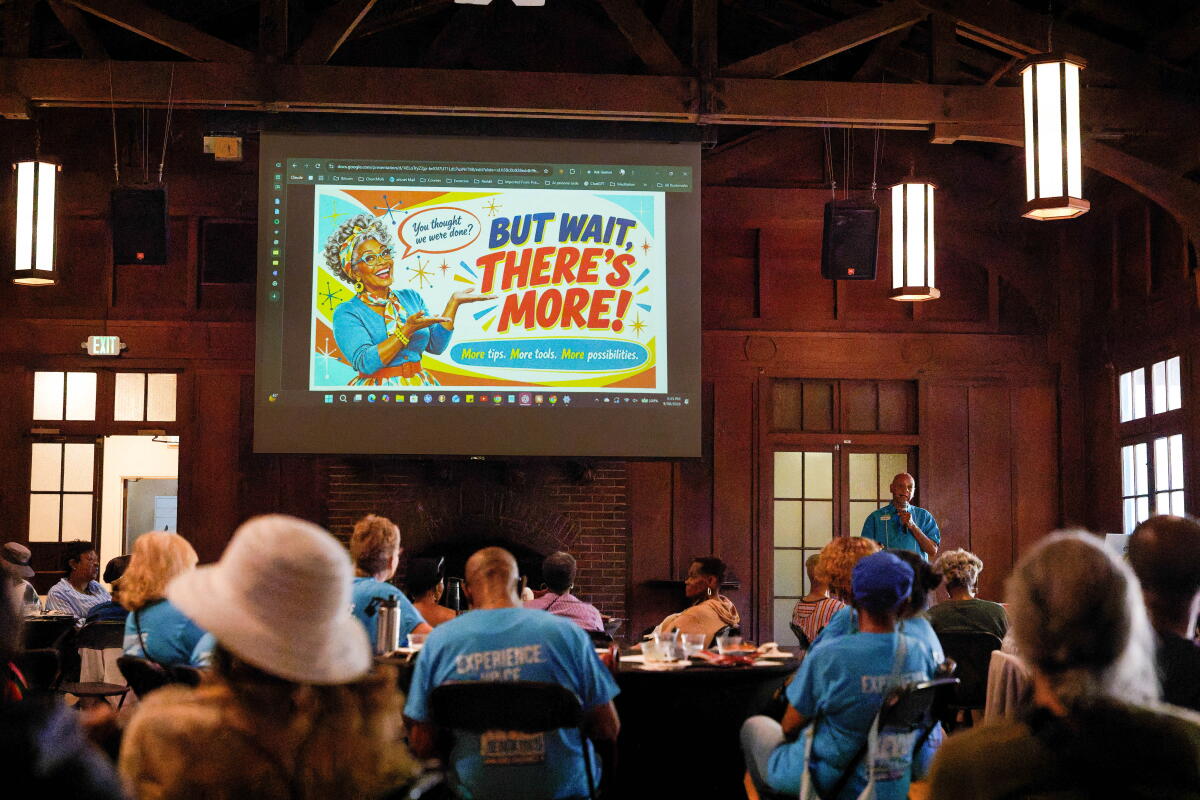
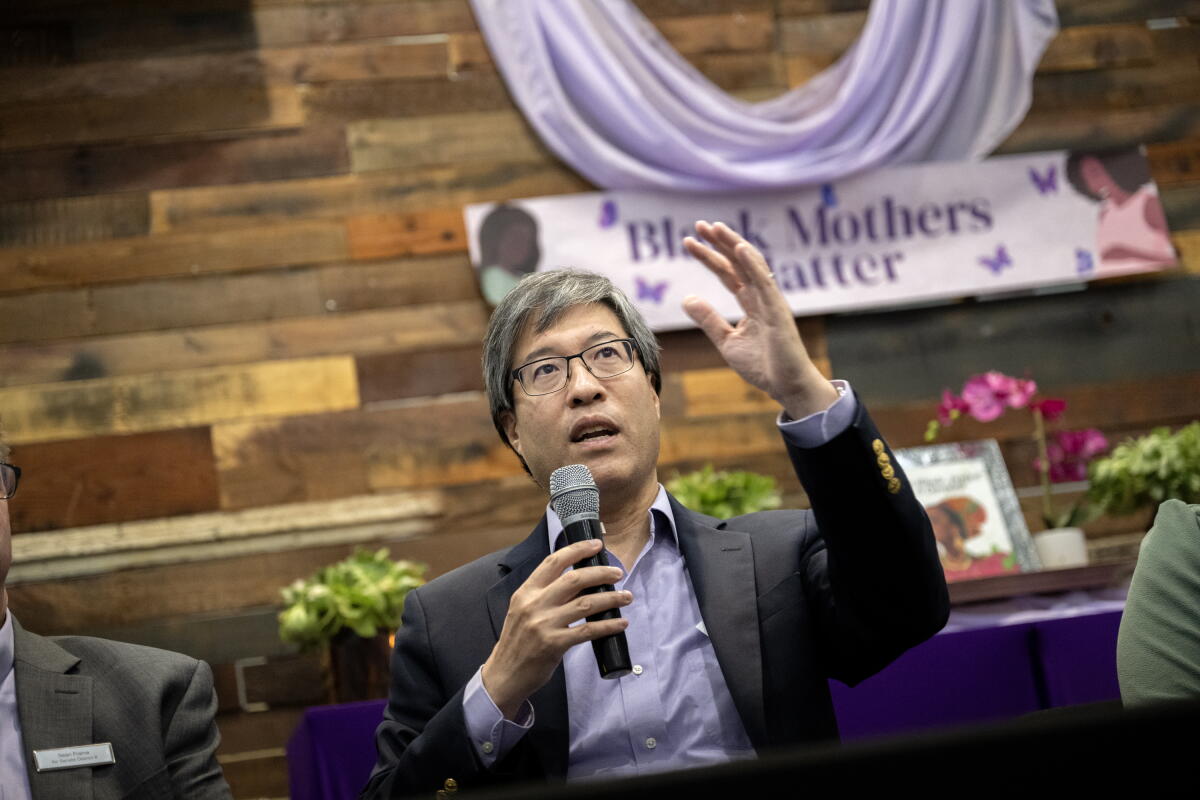
In Oakland, in one event held at Mills College — part of Northeastern University’s global system — titled “Senior Technology Day: Lifelong Learning and Digital Inclusion,” students and senior citizens learned and taught one another about AI.
Participants of all ages expressed concerns about the technology.
“That’s your decision in regard to whether or not you use it,” said Norman Weekes, the AI literacy educator and entrepreneur who presented the topic to the group. “If you never use AI, that’s great, but you should understand it because … it’s going to affect people you love, if not yourself.”
On one hand, people can use AI to build websites or find activities to do. On the other, law enforcement can also request AI conversations, courts can subpoena AI chat logs and chatbots can provide inaccurate information while also flattering people, he said.
Karin Kelly-Givens, 72, uses an AI bot for health questions such as how to understand her blood-test results. Her friends use Gemini to comparison shop for pricey items such as washing machines. But she also grapples with how to use AI.
“Where’s the borderline?” she asked. “What should you not say? What is OK?”
Hayward resident Jason Hughes, 73, downloaded ChatGPT and Claude for the first time. “I might use them both to compare or get more information,” he said.
Fremont High School student May Gutierrez, 17, said that although teachers are concerned about AI being used to plagiarize, they’re also using it themselves. The aspiring designer has safety and environmental concerns about AI, so she’s holding off for now.
“Maybe I’m too much of an optimist, but I hopefully believe that people will see the consequences of AI and not necessarily get rid of it, but work toward making it better,” she said.
(Paul Kuroda / For The Times)
AIMS College Prep High School student Heven Adugna, who aspires to become a physician assistant, said she uses AI chatbots for research and to help better understand math concepts. Although people are using AI in healthcare, she thinks technology can’t replace everything.
“I would much rather have a sincere person telling me what’s wrong than a robot, so from that aspect, I don’t think AI can really take over,” she said.
Olugbala, the Oakland resident who wanted to get Google Gemini off her phone, said she wants to talk to real people using her voice, not bots.
“I want to have more human contact,” she said. “I want to go back and take every opportunity to sit down and get on the phone and talk.”
Opinions expressed by Entrepreneur contributors are their own.
Key Takeaways
You can be deeply confident in what your company has built while recognizing that the right partnerships can help take it further.
To successfully collaborate, you need to know what must remain yours and where partnership adds value. Where do you create unique value, and where could another organization’s expertise multiply it?
Choose partners for what you can unlock together. Don’t evaluate partnerships by the name on the other side.
Understand that the best partners make each other smarter and that you need to set clear boundaries before you collaborate.
Mary Barra, Chair and CEO of General Motors, once said, “Of course we’re going to compete, but in a lot of spaces now, in many industries, you compete and you partner.”
This captures an important shift in leadership. From automotive and AI to healthcare, energy, food and biotech, companies are developing technologies that can transform established industries. But creating the breakthrough is only one part of the challenge. The next is bringing it into a world where decades of expertise, infrastructure and relationships already exist.
At Celleste Bio, we are living that journey. We have developed a new way to produce REAL cocoa ingredients using cell-culture technology, including chocolate-grade cocoa butter that we have already used to create milk chocolate. We are bringing a new capability into an industry with tremendous expertise and knowledge of its own.
I’ve learned that breakthrough technology and collaboration are not opposites. You can be deeply confident in what your company has built while recognizing that the right partnerships can help take it further. For me, knowing how and when to collaborate has become an important part of leadership.
1. Know what must be yours and where partnership adds value
A good partnership starts with clarity about what makes your company exceptional. Your core technology, intellectual property and competitive advantage need to remain clearly yours. You need to know where your company must lead and continue investing in those capabilities. But being exceptional at your core doesn’t mean every capability around your innovation needs to be built inside your organization.
When new technology enters an established industry, it meets knowledge and experience that may have been built over decades. There can be enormous value in bringing those worlds together.
The question I ask is simple: Where do we create unique value, and where could another organization’s expertise multiply it? The strongest collaborations begin with clarity about what each side uniquely brings. You are not looking for someone else to complete your innovation. You are looking at how different strengths can create greater value together.
For me, the strongest partnerships don’t compensate for what a company lacks. They multiply what it already does exceptionally well.
2. Choose partners for what you can unlock together
There is a temptation in business to evaluate partnerships by the name on the other side. A major corporation, respected institution or recognizable logo can create credibility, but credibility alone isn’t a strategy.
A better starting point is the problem or opportunity itself. What are we trying to accomplish? What could move us faster? What could become possible if we bring the right capabilities together?
This is one of the things I value about Celleste’s participation in COCO-AI, a €6.3 million Horizon Europe consortium bringing together companies and research institutions around AI-powered plant cell culture technologies. Different participants bring different areas of expertise and approaches to a shared challenge, while each continues developing its own capabilities and objectives.
Instead of asking, “Who would be a great partner for us?” I believe leaders should ask, “What could we make possible together?” That small change in perspective can lead to very different partnerships.
And this isn’t unique to cocoa. Whether you lead a company in AI, healthcare, energy, biotech or manufacturing, there will be moments when your innovation intersects with expertise that already exists elsewhere. The opportunity is not simply to gain access to that expertise. It is to discover what the combination of capabilities can unlock.
3. The best partners make each other smarter
One of the things I have learned to appreciate most is a difficult question. When you have spent years developing a technology, you naturally know it deeply. Your team has challenged assumptions, solved problems and accumulated knowledge that very few people outside the company possess. That expertise is part of your advantage.
But a partner can look at the same innovation from a completely different position. They may understand manufacturing realities, customers, applications or technical challenges through years of experience in their own field. In return, a breakthrough technology can introduce possibilities they have never had available before.
That is where collaboration gets interesting. I don’t think the best partnerships are relationships in which one side teaches and the other learns. Both should leave the conversation smarter.
A partner should challenge assumptions, bring a perspective you don’t have inside your organization and sometimes ask the question you weren’t expecting. At the same time, you should be doing the same for them. The value is in the exchange.
As a CEO, I have learned to value partners who improve the questions we are asking, not only those who validate the answers we already have. In complex innovation, the right question at the right moment can change the direction of what comes next.
4. Set clear boundaries before you collaborate
Collaboration works best when both sides know where the boundaries are. What are we sharing? What are we building together? What remains proprietary? What does success look like for each side?
Companies need intellectual property, differentiation and competitive advantage. Partnership shouldn’t blur those things. In fact, I believe the clearer you are about what remains uniquely yours, the more confidently you can explore what makes sense to do together. This is also why I don’t see competition and partnership as opposites. Organizations can have different commercial objectives and still find specific areas where their interests align. The important thing is to enter those relationships with clarity rather than ambiguity.
I don’t believe clarity limits collaboration. It creates the trust that allows both sides to be more ambitious about what they can achieve together.
The opportunity on both sides of the table
Entrepreneurs are trained to think about differentiation, and rightly so. What have we built that is unique? What can we do better? What is difficult to replicate? Those questions are essential when you’re creating breakthrough technology.
But once something genuinely new exists, I believe another question deserves equal attention: How far can we take it?
For companies creating breakthrough technology, that means understanding where the right relationships can extend the value and impact of what they have built. For leaders in established industries, there is another question worth asking: What could become possible if we combine what we already know with a capability that didn’t exist before?
I believe some of the most interesting opportunities begin when both sides ask that question.
Breakthrough innovation may begin inside one organization, but its full potential is often shaped by the expertise it meets along the way. And working with an established industry doesn’t make a breakthrough company less ambitious about what it has created.
As Barra’s words remind us: We can compete, and we can partner. The leadership skill is knowing when collaboration can create something more valuable for both sides and help move an entire industry forward.
I went to a party recently. A fancy one, filled with expensive people and interesting clothes.
You might find this surprising, as I expend hundreds of words a week in this publication bemoaning human interaction, but I love parties. I like free champagne, passed appetizers and forced, go-nowhere small talk.
Parties in Los Angeles are even better, because they usually involve at least one celebrity. In the case of this most recent event, the celebrity in question was a Real Housewife of Beverly Hills. Well … technically a “friend of”, Bravo reality TV parlance for a person who isn’t in the main cast and appears sporadically on the show thanks to a social connection to one of the actual Housewives. It’s sort of like being Newman on Seinfeld, or the vice-president of the United States. Easy work, if you can get it.
Of course, I had to inform my friends who are reality TV fans that an orbiting celestial body had entered my field of vision. But how to prove this encounter really happened? Could I truly get the reaction I wanted from them without photo evidence?
I began to ponder how to snap a picture without her noticing. Perhaps a reflection in a mirror? Pretending I was taking a photo of the canapes and whoops, I got you in the corner of the frame. I opted for the clever mirror trick and got the whoa text back from my friends, which means they were sufficiently gobsmacked by my brush with fame.
I was satisfied, but left with the lingering feeling that I was part of a persistent shattering of the few walls of privacy left in our teetering society. I spent actual time from the ticking clock of my life to assess how to take a candid photo of a famous person trying to drink a glass of wine.
What the hell is my problem? At that moment, I felt like I was one more LA party away from tossing my morals in the trash and buying a pair of smart glasses.
Smart glasses are the latest intrusive technological innovation that no one asked for. Instead of just helping you see better or blocking out the punishing light rays of the sun, smart glasses are essentially computers you wear on your face. They can mirror your phone or laptop screen, send and receive phone calls and text messages, and most importantly for the burgeoning creep economy, capture pictures, audio and video.
Smart glasses – from companies like Meta and Viture, which cost about $300 to $500, or nearly $1,300 for a high-end variety from Xreal – are one more incursion by technology into what is left of the natural world. Fly some hideous graphics in my face while I tromp through the park, so I might quadruple-task (naturemaxxing, framemogging some unc feeding pigeons, checking in on my Kalshi, and livestreaming the whole thing) and optimize my 30-minute lunch break.
I don’t think I actually need more gadgets, and yet the product lines keep expanding. I have a phone, a tablet, a watch and glasses that all connect to the internet and feed me hourly distractions and furiously pump me for data.
This is why I can’t imagine any company going to market with a brain implant with wifi capability. Once you’ve stuck a microchip in my head, you can’t sell me anything else to wear.
There are still so many more hunks of metal and plastic with touch screens or artificial reality interfaces to shove into my pocket or on my body. A nose ring that lights up when I get a new like on a YouTube video. Maybe a hat that broadcasts my TikToks 24/7. My body is not my own. It is the property of Meta, a vessel for the free flow of information into the company’s willing gullet.
But what if that sweet online engagement is driven by videos full of people who never agreed to participate?
So, if it seems like almost the entire world thinks smart glasses are primarily for perverts, why does the tech industry persist in suggesting consumers buy them? Surely the obscene profits that Apple collects from the umpteenth edition of the iPhone have seduced Silicon Valley into chasing another world-changing innovation that no one can live without.
Except, we already have the iPhone. And the Apple Watch. And the iPad. I have enough gadgets in my life to pretend like I’m a particularly washed James Bond, engaging in mundane adventures like “creating a shopping list” or “tracking how many times I blink”.
When so much of our economy is tied to “content creation”, it makes some corrupted sense to give the workers trapped in the coalmines shinier pickaxes. I can’t just record an explainer video complaining about declining privacy or voracious technocapitalism. I need a fancier Bluetooth microphone, a camera stand for my phone, a ring light, and maybe even a funny prop like an inflatable flamingo to keep people’s attention.
I can live with all that. After all, I’m the dope who willingly chose to get into the media.
But it’s worse when you use other people to fuel your need for digital attention without asking first. Smart glasses let you do that on a scale, and with an ease of use, that is unparalleled. I could film two people having a domestic spat or a grisly car accident without even having to go into my pocket.
Smart glasses have one actual, unique application – monetizing every last second of life, whether you want it to or not. Now, we can all be a “friend of” in the Real Housewives of Wherever the Hell You Are, performing our silly little dramas for an audience that might never be satisfied.
Dave Schilling is a Los Angeles-based writer and humorist
When last we left our German tourist friend Freddy and his crew, they were in Arkansas, making their way to Texas to see the Texas Longhorns play the Oklahoma Sooners on Saturday.
They saw some of the history of Little Rock and Hot Springs, as well as finding an Arby’s.
As Freddy noted, they also discovered how pretty it could be, and even spotted a bear.
I did not know Arkansas had it like that https://t.co/igDLasQn1d
OMG A BEAR JUST RAN RIGHT ACROSS THE ROAD!!! We just made it to Oklahoma and this guy suddenly appeared right in front of us. This made us rethink our plans of going camping somewhere around here. https://t.co/PoLBvyP7BI
They finally stopped at a non-fast-food stop in Talihina, Oklahoma, and got in some good-looking food at Treats and Treasures, a 1950s-style diner that even has a 1940s soda fountain.
We’ve seen the comments saying we eat too much fast food and should try more local spots. So we did! This was in Talihina, a 925 people town in Oklahoma. I’d say it doesn’t get more local than this. The best part is we only paid $35 for everything (food & drinks!) https://t.co/gWuwyBqXsG
Freddy and the crew tried to get in to see a high school football game once they hit Texas, but they got shut out of the crowded one they were trying to attend in Waxahachie, and had to settle for another game.
Probably the most mind-blowing thing of our trip so far. Everyone told us we had to experience Texas high school football, so we decided to check it out. The stadium holds 9,500 people, which is already crazy considering it’s just high school kids playing. But even crazier was that the game was completely sold out, so we couldn’t even get inside! We couldn’t even find a parking spot anywhere near the stadium. Absolutely insane!
Then it was time for Dallas and the Texas Longhorns vs. Oklahoma Sooners.
We‘re here in Dallas for Texas Longhorns vs Oklahoma Sooners. I think today is gonna be a completely different experience, because it‘s being played at the Cotton Bowl right in the middle of the Texas State Fair. https://t.co/5CXfEwPWLK
Freddy and the crew even got to see Boomer and Sooner, the two ponies who pull the “Sooner Schooner” — the Conestoga wagon of the Sooners.
I don‘t know why I‘ve never heard about this stadium before but this looks iconic. 91,000 capacity! Also there‘s two pony‘s here on the Oklahoma side: Boomer and Sooner. https://t.co/YdIUlox0xz
But then the soccer fan really fell for American football, as the Sooners came from behind.
Oklahoma’s touchdown after Arch Manning’s interception. Top 3 loudest moments I’ve ever experienced in a stadium! (The video doesn’t do it justice) https://t.co/A3SsAlyibJ
He judged the game as “the best sporting event I’ve ever been to.”
I had no signal at all inside the stadium. THIS WAS THE BEST SPORTING EVENT I’VE EVER BEEN TO! We were sitting in the Oklahoma section, goosebumps throughout the entire 4th quarter!!!! https://t.co/7x05BsNEVl
Given all he’s seen, that’s truly high praise. Part of that was that it was a true banger of a game.
In 122 years of the Red River Rivalry, Oklahoma had never beaten a No. 1 Texas team. Until Saturday. And it took every bit of scrap and scrape the Sooners could muster to do it.
If you check the clip, Freddy caught the last part of their comeback win in the last moment of the game, kicking a 47-yard field goal to end it 27-24, and everyone flooding onto the field.
Freddy thanked everyone who suggested they come back for another trip for football, and declared they were now hooked.
I have to say a huge thank you to everyone we met this summer who told us to come back for college football in the fall. This was the best idea ever! Before this trip, we had never really followed American football, not even the NFL. The Super Bowl was the only game we watched. Now, four weeks into our trip, we’ve become such big fans of the sport that we’re already planning watch parties in the middle of the night when we’re back in Germany! After today’s game, we rushed back to our hotel to catch the rest of Alabama vs. Georgia, and now we’re sitting here watching Boise State vs. Fresno State. Never thought we’d get this hooked on football. Thanks for introducing us to this amazing sport! 🙏
Editor’s Note: Do you enjoy RedState’s conservative reporting that takes on the radical Left and woke media? Support our work so that we can continue to bring you the truth.
Join RedState VIP and use promo code FIGHT to receive 60% off your membership.
The first major hazing scandal in American history occurred at West Point in 1900. There are eerie parallels to what happened at Cornell’s Chi Phi.
The fraternity house at the center of a rape allegation stands on the campus of Cornell University on September 30, 2026, in Ithaca, New York.
(Photo by Spencer Platt / Getty Images)
In their polished public pitches, fraternities pledge to provide boys with many vaunted things. Leaders of Greek Life portray themselves as distinctly charitable, intensely communal, and enlightened. In exchange for dues each semester, they promise to provide the time and space necessary to build brotherhoods, find romantic companionship, and forge academic and future career success. What is generally provided in practice, however, are corrupted versions of these things: bonds built through violence, jobs secured without merit, and intimacy taken, not granted.
Hard evidence of the system’s many horrors and hypocrisies have routinely come to light, spurring a response that is generally the same: righteous outcry followed by insufficient, individualized campus punishments, like apology essays or abbreviated dismissals. The guilty fraternity—and sometimes, it’s an athletic team that functions just like one—always seems to elide proper accountability and generally manages to soften the blow for its accused members. While each new scandal leaves scars, the power and relative impunity displayed by Greek Life time and time again has become the institution’s most truly alluring feature.
These dynamics are on vivid display at Cornell University, which, between 2018 and 2024, logged 1,216 cases of sexual assault, domestic violence, dating violence, and stalking. One of these data points represents a 20-year-old Jane Doe who, in October 2024, was allegedly plied with ketamine and alcohol by a brotherhood of boys at the Fraternity Chi Phi, seven of whom subsequently sexually assaulted her. “I felt like bait,” she later said in a closed hearing. “I felt like lions around me.” Less than 24 hours before her gang rape, another student had overdosed on ketamine at the same house. Campus police responded, and made an arrest, but Chi Phi apparently remained in the clear.
The university ultimately launched an investigation into the so-called “Cornell 7,” but only two of the men were actually expelled. The rest secured Ivy League diplomas, including Diego Sarabia, who managed to get a job at Wells Fargo even as he actively remained the subject of Cornell’s inquiry. When the case arrived on the desk of District Attorney Matthew Van Houten, he declined to bring criminal charges, concluding that Doe had started her night by consensually imbibing and was thus as responsible for her behavior as the perpetrators were.
Underlying these egregiously weak responses to campus rape culture is an unstated rationale: that fraternities, like millitary batallions, breed the sort of hard-edged attitudes needed to enforce America’s social order. While often cast as coarse forms of youthful transgression, fraternity violence is, as writer Elizabeth Schambelan once powerfully argued in N+1, “a violent resocialization that better equips young men to wield privilege, put down challenges to existing hierarchies, and police the status quo.”
The power of an individual fraternity network is compounded by alumni of America’s many like-minded organizations. District Attorney Van Houten, for instance, graduated from America’s original power fraternity: West Point. Just as Chi Phi dresses up its ugliness with the credo “Truth, Honor and Personal Integrity,” West Pointers purportedly dedicate themselves to the ideas of “Duty, Honor, Country.” Van Houten himself boasted in a letter to his local newspaper years ago that he was “uniquely qualified” to address the concept of “honor.”
Current Issue
Honor is traditionally equated with honesty, integrity, and accountability, though, definitionally it doesn’t require any of these things. All it actually denotes is a fidelity to an institution’s core rites and standards, which men may go any length to meet, often confusing that fidelity for masculine kinship. For the “Cornell 7,” impressing one’s fraternity members was likely more important for each of the men in that moment than the well-being of the woman who happened to be in the room upstairs. Perhaps their gross abuse of Doe felt empowering in the moment, though it came at a deep moral cost, a spiritual degradation that netted nothing more than cheap power and pleasure.
The first major hazing scandal in American history occurred at West Point in 1900, under a system designed by a pair of former fraternity brothers at Dartmouth. At the time, there were no women to abuse at West Point, and so the worst behavior befell the men, in this case, Oscar Booz, a smart but relatively small cadet who was targeted for actively opposing the school’s despotic hierarchy. Senior cadets forced him to chug Tabasco sauce, and to square off in West Point’s underground fight club—all rituals that one wouldn’t be surprised to read about in a college newspaper today.
Booz’s unrelenting abuse left him in failing physical health. After only a few months at West Point, he returned home. A family doctor discovered bruises across his body and observed that his throat was badly swollen, likely from the hot sauce. He died soon thereafter from a rare form of tuberculosis in his larynx. He was 19.
One of the purported masterminds of cadet hazing in Oscar’s day was William Augustus Mitchell, who had previously served in a senior leadership position at Alabama Polytechnic Institute’s chapter of Sigma Alpha Epsilon. It was an early and illuminating example of the long-standing interplay between military and civilian frat life, one that has since leaked into corporate environments, athletic teams, and American government.
There are today numerous military-style fraternities, including Mu Beta Phi, Kappa Lamda Chi, and Kappa Alpha, the last of which long harbored ties to white-supremacist figures and counts as its spiritual godfather Robert E. Lee. In 1904, the War Department established a complementary fraternity for ROTC cadets called Scabbard & Blade. The group was oriented around hazing and physical drills. This suffering was rewarded with shiny service badges and the promise of women. For much of the 20th century, college men would join numerous specialized frats, and archival materials show many who pledged both Chi Phi and the Blade.
This formed a culture of cross-contamination, with chapters influencing each other on how to haze and how to covet—and objectify—women. Chi Phi chapters, like Scabbard & Blade, routinely held debutante dances to crown an “IdealGirl,” and threw parties they publicized in the paper listing the names and photos of pretty women who planned to attend. The Blade also pioneered an initiation event—the “Kissation” ceremony they called it—that eerily echoes the behavior of the Cornell 7. For an entire day, young Blade pledges would be set loose on campus to “catch” and kiss unsuspecting female students. The University of Arizona chapter reported one year that “some 250 girls were ‘pledged.’” The paper also noted that “coeds openly gripe” about the practice, in part due to the “en mass idea,” and to the “jeering audience” who witness these violations. For the Bladers involved, the ritual was more about the masculine virtues of competition and domination than anything else. The more catches, the better, no mind the embarrassment of the women involved.
Popular
“swipe left below to view more authors”Swipe →
Never have these practices, or the institutions that perpetuate them, been seriously challenged by college administrators. Inevitably, then, they have grown and mutated. The case of the “Cornell 7” is not simply a story of bad apples but also of a college that has offloaded key social and development responsibilities to aberrant institutions. Cornell purportedly boasts 44 fraternities, plus other secret societies, like the Order of Omega, Quill and Danger, and the Sphinx Head, which students will do anything to be tapped for as means of social currency. The Ivy also appears to be one of the last colleges in America with an active & Blade chapter.
It may be tempting to view fraternities as an anachronism, or to hold out some hope that this latest wretched scandal may be the one that finally puts the nail in the coffin. But the truth is that their ranks are only swelling post-pandemic as a generation of students plagued by social isolation look for ways to connect with one another. The fact is that fraternities and collegiate sports teams, alongside the military, remain the overwhelming prescription for man’s ills. So long as America continues to fail its boys, they will struggle to impress their counterparts, taking women as casualties in their wake.
When you think about horrible things Americans have endured, you immediately think of 9/11, President John F. Kennedy’s assassination, COVID-19, or the Japanese bombing of Pearl Harbor. But Hillary Clinton says she has something that ranks up there, too — her 2016 presidential election loss to Donald Trump. Yes, she really compared her well-earned defeat to 9/11 and COVID.
Insane. (READ)
Hillary Clinton lumps her 2016 election loss in with “a series of hard times” the country has endured like 9/11 and Covid.
“We had an election in 2016 that raised a lot of questions that we’re still trying to find answers for about what kind of really went on.”
The hubris here is next level.
She’s never going to accept that loss.
To her, it’s a national trauma.
Hard times? The only thing ‘hard’ on the day Hillary Clinton got trounced was how hard our sides were hurting from laughing at her humiliating defeat. (WATCH)
Hillary Clinton lumps her 2016 election loss in with “a series of hard times” the country has endured like 9/11 and Covid.
“We had an election in 2016 that raised a lot of questions that we’re still trying to find answers for about what kind of really went on.”
If anything, Trump obliterating Clinton was one of the best things that has happened to America in this century.
Posters are not surprised that Clinton still can’t move on from being denied the presidency she thought she richly deserved.
Ever since that election, she has never demonstrated an ounce of self – reflection, always just “Russia did it”, “It was because I am a woman”, “Trump voters are a cult”, etc.
It’s been 10 years, and she still can’t come to grips with it or see how her loss was her own fault.
Clinton didn’t become President, but that hasn’t stopped her from living vicariously through a Democrat who has. (WATCH)
Hillary Clinton: When I was at the opening of the Obama library—Michelle Obama gave that speech about all of the things that her husband had done that the other guy has not, when she got to the Nobel peace prize, I just burst into laughter. I thought it was so perfect. Barack… pic.twitter.com/2pjXkGsqvn
(post continues) …Obama turned around and grinned at me. I leaned forward and said I really hope that Donald Trump is watching this. Barack said, “Me too”
Hillary Clinton (a/k/a The woman who will never be President) has been irrelevant for over a decade now, but favors us with periodic public appearances wherein she lets us watch the cheese slide off her cracker as she slips deeper & deeper into psychosis.
Editor’s Note: President Trump is leading America into the “Golden Age” as Democrats desperately try to stop it.
Help us continue to report on President Trump’s successes and combat Democrats’ lies. Join Twitchy VIP and use promo code FIGHT to receive 60% off your membership.
As raw milk becomes increasingly popular among Americans, there have been several recent disease outbreaks tied to the product, alarming public health officials.
Last week, the American Academy of Pediatrics called for a ban on sales of unpasteurized milk in the United States.
More people have started drinking raw milk, doctors say, because of influencers who have touted its health benefits; Robert F Kennedy Jr, the US health secretary, who until recently promoted it; and a lack of trust in government regulators.
But there is no evidence for claims that it reduces lactose issues and can cure allergies and boost immunity, the Food and Drug Administration (FDA) and public health groups argue. And whereas raw milk producers say that pasteurization eliminates flavor and health benefits, public health officials say it keeps people safe.
“I’m concerned about people consuming raw milk because while it isn’t a guarantee that you will get sick from it, there is a relatively high likelihood that you can get a pathogen, a bacteria that will make you sick,” said Petra Levin, a professor of biology at Washington University.
US businesses started using pasteurization, a process in which milk is heated to destroy pathogens and bacteria, in the late 19th century. As more producers adopted the practice and regulators started requiring it, the country saw a dramatic decrease in the infant mortality rate. In 1987, the FDA banned the interstate sale and distribution of raw milk, but businesses were still allowed to sell it within their states, depending on their laws.
During this century, more Americans started consuming raw milk and, over the last decade, many states have loosened their milk regulations. In 2024, raw milk sales increased by 17.6%, according to the market research firm Circana.
Before becoming the health and human services secretary, Kennedy said on stage that he only drinks raw milk and vowed that the “FDA’s war on public health is about to end”, including its “aggressive suppression” of raw milk.
Once in office, he took a shot of raw milk with Dr Paul Saladino, a psychiatrist and author of The Carnivore Code – but to the dismay of some in the industry, Kennedy has now apparently stopped advocating for it. The Trump administration now instead promotes whole milk.
Ben Beichler “fell in love” with milk cows while farming and, eventually, he and his wife started their own operation, Creambrook Farm, in Virginia. They now milk 150 cows and legally sell raw milk through a “herd share” loophole that allows consumers to buy a share of a cow.
He describes the Covid-19 pandemic as a “massive gamechanger” for his business because people started thinking more about how they could protect themselves from getting sick.
Plus, “for better or worse, I think there is a skepticism in society that didn’t exist pre-Covid, and people are willing to question things more than they used to. So that has made people question a lot of their dietary needs,” Beichler said. “I’m not necessarily saying that skepticism has been a good thing.”
Since 2020, his sales have increased between 30% and 50% annually, he said.
As evidence of raw milk’s benefits, Beichler and others point to studies such as a 2011 report in the Clinical & Experimental Allergy journal which stated that “consumption of farm milk may offer protection against asthma and allergy”.
But the FDA states that advocates have misused the findings because about half of the farm milk in the study was boiled. Also, the authors stated that they could not evaluate the “effect of pasteurized vs raw milk consumption because no objective confirmation of the raw milk status of the farm milk samples was available”.
“At this stage, consumption of raw farm milk cannot be recommended as a preventive measure,” the study authors stated.
To ensure his milk is safe, Beichler said, his farm tests every batch at its laboratory and then sends samples to a third-party lab. He declined to provide its name but said he would provide it to customers who ask for it.
His farm has only five-star reviews on Google.
“An honest and wholesome family who can provide safe and nutrient dense milk to the many people who are drinking raw milk these days,” one review stated.
Despite his belief in raw milk, Beichler said that “the consumer has to be judicious” about “where they are getting” it.
This summer, more than 100 people became sick after consuming raw milk, and 11 were hospitalized, according to National Public Radio. An E coli outbreak this year in California, Florida and Texas was also linked to cheese from the country’s largest raw milk distributor, Raw Farm. Most of those who fell ill were children ages three and younger.
Dr Brian Dawes, an infectious disease specialist at Stanford University, said raw milk is especially dangerous for children because “they have weaker immune systems, less overall physiological reserves, so when they get these infections, they tend to get much sicker”.
He supports a ban on raw milk. He said he also thinks public health leaders “have our work cut out for us to really regain public trust in the systems that have worked for milk for over 100 years, keeping people safe”.
With the midterm elections less than a month away, it would seem to be an absurd time to suffer a thought for the next election cycle and the challenges that any would-be Democratic presidential victor would have to tend to on day one. Unfortunately, sometimes current events intercede with a potent reminder of just how rough the road to recovery and post-Trump renewal will be. One such story broke this week in the pages of The New York Times, which detailed some of the Trumpian luminaries who have recently ascended to important positions at the Department of Justice’s Civil Rights Division, run by Trump acolyte Harmeet Dhillon.
The piece wastes no time: In short order, we’re introduced to “a former prosecutor forced off a high-profile murder case for peeking at the defense team’s strategy documents,” a “onetime gambling executive” with a sideline in promulgating “conspiracy theories about the Las Vegas massacre in 2017,” and a “Florida activist” whose “activism” included being jailed for several weeks for “hacking a local election system.” The long and the short of it is that the agency, once stocked with skilled professionals, is now chock-full of people who ordinarily wouldn’t pass the smell test for public service. Somewhere, a pool is missing its cess, and they might want to check whether it ended up at the DOJ.
Much has been made of the way the Trump administration, returning to power with Project 2025 as its guiding manifesto and Elon Musk as its chainsaw-wielder, went to war with the civil service in the hopes that it could be ground down by purging the dedicated civil servants who’d previously staffed whatever posts were relevant in keeping us free of cyclospora. This Times story is covering the other side of the equation: The full Trumpian takeover isn’t just about firing people en masse. Frankly, it’s not merely about placing people loyal to the cause in top positions. It’s about stationing borderline lycanthropes in powerful positions.
Daniel Flickinger, who began working on the division’s education cases earlier this year, was forced out of his job at a Birmingham, Alabama, law firm in 2020 after suggesting—to the disgust of his bosses—that George Floyd was fortunate to have died in a “fentanyl- and methamphetamine-numbed strangulation” because “it meant being worshiped in a nationwide funeral.”
Peter Feaman, a veteran lawyer from Florida hired in early 2025 as a senior counsel, has a history of far-right political statements. In a May 2021 post on social media, he accused the “diabolical” Democratic governor of Michigan, Gretchen Whitmer, of forcing citizens into getting the “mark of the beast” (a coronavirus shot).
This isn’t going to be a temporary problem by any means. The idea that the Trumpers who’ve come to Washington might take their leave if and when the federal government comes under Democratic control is a hopeful notion, but I worry that some of the true believers aren’t just here visiting; they intend to stay. That’s certainly the sense that Health and Human Services Secretary Robert F. Kennedy Jr.—who’s gone to great lengths to stuff the agency under his control with all manner of cranks and quacks—strove to convey at last week’s MAHA Summit in Washington, D.C. As MotherJonesreported, Kennedy “proclaimed the changes he’s wrought to HHS are permanent, and praised his allies in the movement for helping to make them happen.” “Even if I got hit by a truck tonight,” he bragged, “HHS will never go back to what it was before.”
When it comes to government agencies that have suffered the most from this Trumpian takeover, none are as complete or as concerning as the Department of Homeland Security. On its best days, DHS is a walled garden of cops all hotboxing themselves with reactionary politics. Under Trump, it’s essentially become a hive of outlandish herrenvolk propaganda, pumping neo-Nazi memes into the social media bloodstream—the better to recruit the sort of person who might want to inflict terror on the streets of American cities.
As The New Republic’s Melissa Gira Grant documented, DHS’s tainted origin as a post-9/11 agency with a monomaniacal focus on Muslim extremism—and with a storied history of downplaying the threats of white nationalism—has only grown even more corrupted by the second coming of Trump. “We are doubling back around the same circular path,” Grant observed, “where agencies such as DHS downplay white nationalist violence, both potential and actual, while they draw recruits from those same ranks.”
For a future Democratic president, the challenge of righting the ship of state will not simply be a matter of reviving the federal workforce and bringing competent professionals back to the perches they once occupied. It will be a matter of fumigation, as well—or, to use a better term, lustration, which Yale Law professor Dina Francesca Haynes, writing immediately after the first Trump administration, defined as “the process of vetting and removing from public service those who engage in or support extremism or seek to undermine democracy.”
Lustration, Haynes explained, “has been carried out or proposed in many countries attempting to pull themselves from the wreckage of fascism, genocide, and nationalism.” As Haynes described, the idea is that for a country to successfully “move forward” from its authoritarian past, “it must rid itself of corrupt public servants by vetting them, and potentially dismissing from employment and cancelling pensions of those who harbor such deep bias that it would be impossible for them to fairly and impartially exercise the discretion they have been granted by virtue of their position in public service.”
This is something that those of us at The New Republic have already begun considering as a necessary bridge back to a functioning democracy. In fact, as The New Republic’s Matt Ford pointed out as he gamed out what a future president could do to gut ICE, Trump himself has already provided the working blueprint for a quick and effective purge of any Trumpian fifth column that might remain gummed in the gears of government after the president leaves office. A future president can claim the same “vast powers to decide the fate of federal agencies,” including terminating employees, cutting funding, and transferring staff and programs to other agencies.
Elsewhere, Ford also suggested that a future Democratic president make use of the power Trump claimed for himself to “reduce headcounts through a reduction in force, perhaps by firing every agent hired since 2024.” As Ford opined at the time, the administration’s “decision to drastically reduce hiring standards for incoming ICE agents would more than justify such a sweeping action.” That the DOJ’s Civil Rights Division is studded with people who shouldn’t be managing a Pizza Hut, let alone prosecuting civil rights offenders, suggests there is ample room to expand these principles of lustration throughout a Trump-tainted civil service.
As I’ve said before, the right way to think about the Trump administration and its wholesale operations across the federal government is to accept the fact that it is essentially a criminal syndicate, dedicated to self-enrichment and political corruption. The next Democratic administration should have accountability on its mind, and a commitment to rooting out the Trumpian rot that’s infected the civic architecture of this great nation. It might be that the most useful thing the Trump administration has accomplished in its odious lifetime is to provide the playbook to right its wrongs and dismantle Trumpism permanently.
This article first appeared in Power Mad, a weekly TNR newsletter authored by deputy editor Jason Linkins. Sign up here.
This week, one of the most talked-about stories has been President Donald Trump’s decision to spend taxpayer money on campaign ads that the administration is misleadingly characterizing as “public service announcements.” The move is vintage Trump in that the ads are both staggeringly corrupt—the administration is spending $20 million of the Department of Homeland Security’s money on them, in violation of the Hatch Act—and propagandizing slop. One ad, which uses a song without the artist’s permission, has Trump asking people, “Love me.” Another warns of a “final battle.” So far, the administration has only spent a fraction of the money that’s been allocated to this endeavor, so you can count on seeing many more iterations of these fake PSAs, which Trump is said to be guiding.
But rather than think of this as some kind of flex, or one more scandalous abuse of the public trust, I want to suggest that what these ads represent is desperation—an acknowledgment that if Trump’s goose isn’t cooked yet, the pot is at least boiling. I also think, if anything, this fusillade of propaganda will likely backfire.
These ads haven’t generated good news for Trump; very few people outside of the administration and its obvious sycophants have tried to defend them. Moreover, the media seems resistant to give this story the “both sides” treatment. As with Trump’s 25-minute prime-time ramble last July, the political press seems wise to what’s going on. Of that aforementioned speech, TNR editor Michael Tomasky said, the overall reaction to the president’s attempt to shine us on “tells us that that power he had over people and institutions a year or 15 months ago has evanesced.” I think these PSAs do little else than advertise that fact.
I am not sure that Republican lawmakers necessarily agree with that assessment, but their own appraisals range from avoidant to withering. As MS NOW reported this week, “even congressional Republicans are expressing concern that the ads may violate the laws governing PSAs.” Senate Majority Leader John Thune is quoted in the piece as saying that he didn’t mind the message of the ad but believed “it shouldn’t be paid for with taxpayer dollars.” That’s about the nicest thing any Republican who made their way into the story had to say about it, with Senator Mike Rounds saying, “It’s not something I would have done” and the outgoing Thom Tillis comparing it to Viktor Orbán. “I hate it,” said Tillis, bluntly.
Trump’s midterm activities aren’t limited to these controversial ads. According to reports, the president is planning to spend 32 of the next 35 days on the road campaigning for Republicans. As Politico notes, many of his intended destinations suggest the GOP is in tremendous peril. Instead of swing states and traditionally competitive districts, Trump is visiting “bastions of conservatism” like Alabama, Oklahoma, Ohio, and Texas. He’s even going to trek out to Alaska, “a significant commitment of time and presidential resources that underscores how dire the situation is for Republicans.” As one GOP donor told Politico, “The problem is that the fires are everywhere right now.”
The biggest question is whether Trump’s growing effort to further inject himself into the midterm cycle is going to help or hinder the electoral hopes of Republican lawmakers. In at least one contentious race, the Republican candidate is calling Trump an albatross. According to leaked audio obtained by The New York Times, Texas Senate candidate Ken Paxton told a room full of donors that Trump’s weird midterm convention in early September—which was held in Texas, in the hopes it would boost Paxton—had the opposite effect. “So to be honest with you, the numbers—when we did that convention—it dropped our numbers. Everybody’s numbers dropped. Right now, yeah, not good.” (As Lawfare editor Eric Columbus pointed out, it’s also not good “when your 12-person private fundraiser includes someone who hates you enough to leak damaging audio.”)
The Paxton audio is a potent snapshot of some larger trends. All across the country, we’re seeing stories of GOP strongholdsedging toward collapse as onetime Trump voters bear the weight of his administration’s incompetence. There are daily reminders that other Republicans are trying to create distance between the president and their campaigns, and even defying him on key matters. On Wednesday, in fact, West Virginia Senator Jim Justice broke with Trump on the matter dearest to the president’s heart—his mass deportation machine. “Maybe we’re doing something wrong here or there,” he said. You think?
Over the course of the year, as Trump’s approvals hit new lows and began to decimate the GOP’s midterm ambitions, I’ve tried to figure out what Trump and his fellow Republicans could do to reverse or even just arrest those trends. For a brief mad moment, I thought that the negotiated Memorandum of Understanding between the U.S. and Iran might provide a springboard Trump could use to extricate himself from his crazy war. This didn’t come to fruition. The truth is, to save their bacon, Republicans would have to do things they are genetically incapable of doing: improve people’s lives and fix the economy. As I pointed out two weeks ago, Republicans—despite their misgivings about Trump—are still touting their One Big Beautiful Bill Act: a document that says the wealthiest among us deserve thousands of extra dollars, and the rest of us deserve some measure of pain.
It’s all adding up to defeat. The Cook Political Report says a Democratic takeover of the House is a “done deal” and that winning the Senate is “very realistic.” The Quinnipiac generic poll of the House has Democrats opening up a 51 percent to 39 percent lead, which are bloodbath numbers. The only headwind Democrats face is that while voters seem willing to give them their vote this year, they’re not as ready to give them their affection. Still, you’d rather be the Democrats right now than the GOP, who like Vice President JD Vance have been left begging voters for a “second chance” without understanding that they’ve already received that second chance—and they’ve blown it.
This article first appeared in Power Mad, a weekly TNR newsletter authored by deputy editor Jason Linkins. Sign up here.
One of my many cataloged memories of the Trump era is from the run-up to the 2016 election, when one of my colleagues related to me what one of his sources in Brazil, fretful about Donald Trump’s rise, told him. “It’s OK for the world for Brazil to occasionally be a basket case nation,” he said. “But the thought of the U.S. becoming one is really disturbing.” This week, Trump addressed the U.N. General Assembly, cast in the role we once reserved for people like Mahmoud Ahmadinejad and Muammar Qaddafi: the batshit egomaniac dictator (only this time, with nukes). It seems to me that we’ve well and truly failed the basket case test. But a new poll has given me some fresh worries on this front—and a concern that maybe too many of us have developed a little taste for misrule.
The survey was published this week by Liberal Currents and it sought to catch the mood of the Democratic electorate as Election Day looms. Much of what the poll found was downright anodyne: A plurality of respondents favor Kamala Harris as the presidential nominee in 2028; “economy, inflation & cost of living” wins as the respondents’ biggest issue they want a future Democratic president to tackle. But one result made me do a double take. Under the section, “Feelings about Trump leaving office,” respondents were asked, “If you woke up tomorrow morning and saw the following news headlines, how would you feel?”
One of the choices, “To ‘safeguard the Constitution,’ a group of U.S. military leaders have removed President Donald Trump from power and assumed control of the United States” earned a net approval of 31 percent, with 59 percent approving and 28 percent saying no. That’s not good! Now the reason I’m not completely disassociating is because the ways respondents answered the other choices were more rational: Impeachment was by far the favored choice of removing the president, at 80 percent net sentiment, followed by removal via the Twenty-Fifth Amendment at 77 percent, and “dying peacefully in his sleep” at 40 percent. Assassination—by far the most immoral and dangerous way Trump could leave office, for all the reasons I lay out here—was the only choice with a negative sentiment, as it should have.
Still, I’m sorry, but the approval number for a military junta taking over the United States is way, way too high. Folks, you do not want a military coup in the United States under any circumstances.
Perhaps one reason this idea polls so well is that we’ve recently had a sample taste of what it’s like to be under unconstitutional leadership and it led to a desirable outcome. During the January 6, 2021, insurrection and for about a fortnight after, the United States was for all intents and purposes governed by a weird triumvirate: Nancy Pelosi, Mike Pence, and General Mark A. Milley. Trump was, during this time, meaningfully constrained from exercising some of his constitutional authority, while this troika took it up. It can be argued, of course, that this may have been for the best. This interregnum eventually yielded to the Biden administration and its comparative normalcy. But for many people, myself included, it was still fairly unsettling. In many places around the world, such takeovers end badly.
This is perhaps why the basket case anecdote came flooding back in my memory banks, as Brazil’s history is demonstrative of why military coups d’état are a bad idea. If the Latin American nation is any guide, once you start having military takeovers, you tend to keep having them. As the Berlin Journal’s James N. Green recalls, “Since 1889, when the Brazilian army ousted Emperor Pedro II and established a republic, the armed forces initiated nine attempted takeovers, five of which were successful.” Brazilian history also teaches us that military takeovers can be very difficult to dislodge. “The last military intervention into Brazilian politics took place in 1964, with the explicit support of the U.S. government,” writes Green. “It led to a 21-year-long military dictatorship.”
I feel it should be obvious to most that a Trump-ousting coup would be an incredibly combustible event that would shatter the political landscape and lead to widespread uproar that would be difficult to contain. As I’ve noted previously, the MAGA movement is steeped in conspiratorial thinking and bound in cultlike devotion to Trump. Martyring him is thus a very bad idea. A military-style coup d’état would likely reinflame the passions that led to the January 6 insurrection, and serve as rocket fuel for the growing number of people who TNR’s Matt Ford says claim “a purported Second Amendment right to murder civil servants and assassinate elected officials.”
As TNR’s Tim Noah wrote earlier this week, one Trump-removal scenario that’s on the table comes down to the GOP’s long-term political thinking: Should Republicans get battered in the midterm elections, there could be a strong incentive to convince Trump to retire or quit and pass the torch early to Vice President JD Vance, so as to allow him two years to essentially run as an incumbent. If that’s the way it goes, so be it. Trump would, of course, have strong incentives to stay, as his becoming a private citizen again would immediately embroil him anew in any number of legal battles.
Barring that, the constitutional methods of removal that most Democrats thankfully seem to favor are the better options—though it seems that impeachment is, for Democratic leadership anyway, off the table. Perhaps it would be impractical for a newly empowered Democratic Congress to try impeachment for a third time (though they say that’s “the charm”). Still, it’s worth remembering that Republican senators had two shots to end a derelict presidency—once immediately after he sicced a mob on them—and they failed in their duty to oust Trump and bar him from holding public office. In this way, impeachment should remain a salient issue in this autumn’s Senate races: All of the miseries we are experiencing right now would never have happened if enough Republican senators truly loved their country.
It needs to be said that if Trump’s reign is to end prematurely—that is, before his stepping down on the next Inauguration Day—things won’t be peaches and cream. Even if it comes about through constitutional means, the U.S. will have to navigate a period of tumult. If we’re contemplating the end of the Trump presidency, rather than indulge in fantasies about a military coup, we should all contemplate how each of us, in our own way, might help reinforce the civic foundation and serve as good stewards of a nation of laws. Perhaps, as Noah writes, we’re within sight of Trump’s fall. We should not take such matters lightly, because if the fall is all that’s left, it matters a great deal.
Last week, President Donald Trump announced that if Republicans prevail in this year’s midterm elections, he would provide everybody with a $5,000 dividend check. People reacted as if he’d said something crazy, like “Barack Obama was born in Kenya and is ineligible to be president of the United States”—by which I mean they dismissed his ravings as one more Trumpian oddity and not what it really was: the disqualifying lunacy of a corrupt jackass. A few brave souls gently raised concerns that this was tantamount to a bribe. Those who wanted to add something substantive to the conversation pointed out just how much this idea would cause inflation to spike. I don’t recall anyone saying the obvious thing: A $5,000 payoff would be an implicit admission that he and his party’s reckless policies wrecked the economy and spawned a nationwide affordability crisis.
House Speaker Mike Johnson, whose flock of lawmakers would ostensibly be the people who would find this money—more than $1 trillion—and appropriate it, told Kristen Welker in an interview that the so-called “Trump dividend” would be something lawmakers would “process through Congress and talk through and debate and discuss.” That said, nothing is happening anytime soon, because Johnson is sending lawmakers home until the midterm elections so as to avoid having to vote on GOP Representative Thomas Massie’s proposed impeachment of Secretary of “War” Pete Hegseth, who, between psychosexual panic attacks about the masculinity of the soldiers in his presence, is currently getting the belt-to-ass treatment from Iran.
So you might have to wait a while for your $5,000 check. But that doesn’t mean that the Trump dividend hasn’t already been paid out. To the contrary, the president and his congressional enablers have been handing out money left and right. They’ve made people very rich, in fact. It’s something that they’re quite good at doing—at least for a few.
Once upon a time, Trump claimed that shared prosperity would come in the form of tariffs, which he believed would rake in such a large amount of revenue that the income tax could be abolished. This was insane in theory; in practice, Trump’s tariffs only followed the logic of the president’s ire—whatever nation was pissing him off that week would get tariffed. The Supreme Court eventually ruled that most of this nonsense was illegal, not that it diminished Trump’s yen for trade war.
But it’s not all bad news. As ABC News reported last month, the administration has paid out $100 billion in tariff refunds. That ought to excite everyone. After all, the Tax Foundation estimates that the tariffs that the Supreme Court ruled to be illegal cost every household $700, so a reimbursement might be helpful in filling up your gas tank three or four times. But as ABC News notes, “most consumers—who paid higher prices from the tariffs—aren’t seeing that money go back into their pockets.” In some instances, firms have plans to repay some of that money to consumers. But in other cases, that money is being pocketed, with some corporations earmarking the money for “reinvestment” and others putting it toward offsetting the other high costs they face because of Trump’s handling of the economy and the Iran war.
And for small businesses, these mini windfalls have arrived too late. Per ABC, one fortunate recipient of a $50,000 refund says “she was forced to cut staff and use her retirement savings to keep the business afloat” while waiting for her refund pittance. That’s wreckage the check won’t cover. All in all, Trump’s “Liberation Day” mainly liberated money from your pocket. Whether it makes its way back to you or remains in the coffers of corporations is anyone’s guess.
Meanwhile, people seem to be forgetting that Republicans in Congress have already passed a measure that put $5,000 in Americans’ pockets—or to be more precise, $5,190 to Americans earning between $153,600 and $361,400. That law is called the One Big Beautiful Bill Act, which has been one big beautiful means of cementing income inequality across the country. As the Institute on Taxation and Economic Policy reports, the OBBBA “favors the richest taxpayers and provides working-class Americans with relatively small tax cuts that will in many cases be more than offset by the import taxes, or tariffs, imposed by President Trump.” The richest 1 percent got way more than five grand in this deal—their tax savings were in excess of $66,000. At the other end of the spectrum, the poorest 20 percent got a paltry 40 bucks. Don’t spend it all in one place! (Actually, many folks cannot because the same bill ended the Affordable Care Act subsidies they were using to purchase health insurance.)
Republicans’ monomaniacal focus on re-enriching the already rich is doing much more than thieving money from your pocket. Wealth concentration is increasingly locking most of us out of the American dream. As a 2024 study from the Institute for Policy Studies and Popular Democracy found, wealth concentration is “supercharging existing problems of gentrification, homelessness, unaffordable rental housing, and out-of-reach homeownership.” Across the country, predatory billionaires are buying up single-family homes, keeping many of these properties vacant so as to “profit from real estate speculation,” and invading the short-term rental market to play the same tricks, thus keeping units at arm’s length from would-be renters. Trump and GOP lawmakers have enabled all of this through policies that have—as of Tax Day 2026—grown billionaire wealth 30.6 percent.
If you’re like most people, you could use $5,000 right about now. As a recent memo from Americans for Tax Fairness noted, “Working Americans have had to pay more for health care, gas, and food while their paychecks have remained stagnant or fallen while been in office.” Meanwhile, as Republicans wiggle and dodge on the Trump dividend checks, they’re out in public touting the very bill that led to all of this widespread immiseration—and hiding the fact that when the Medicaid work requirements slated to be imposed after the midterms go into effect, an estimated seven million people won’t have health insurance anymore.
Lots of people have gotten the Trump dividend: Trump himself, his family, billionaires, many corporations, even that weird Dick Tracy villain guy who broke the Reflecting Pool. But Trump’s long history of stiffing people should be more than enough to dissuade you from the belief that a check is coming your way if the GOP retains its majorities in Congress. If history is any guide, the Republicans would keep fleecing you. But the Trump dividends will continue to flow, and many people will keep getting richer. As they say, it’s a big club, and you’re not in it.
This article first appeared in Power Mad, a weekly TNR newsletter authored by deputy editor Jason Linkins. Sign up here.
In the theater, there’s an old saying about “Chekhov’s gun” that basically goes like this: If the playwright shows the audience a gun in the first act, you are locked into a certain plot inevitability—that gun will go off in the final act. It usually ends badly. This week, a couple of folks at Anthropic—one who was sounding the alarm on his way out the door, the other still merrily employed there as a safety researcher—effectively showed us the AI gun. Who might die in the final act? According to reports, “All humans.” How soon? “The people building AI earnestly believe that it could kill us all by the end of the decade.”
Cool, cool, cool. If I could offer my hot take, maybe someone should do something to, you know, stop this? Unfortunately, there is a series of related problems that impede the easy fix. For starters, our political system is awash in tens of millions of dollars spent by the AI industry. AI is not popular with the general public, but it is very popular among the few who expect to get, or already are getting, insanely wealthy from it—and they have all burned through small fortunes of sunk cost in this arms race, where everyone is trying to build the best (read: most destructive) AI model they can before someone else does. And the industry actually makes a habit of regularly informing people that this tech could kill us all, because when they do, it excites investors.
It is actually genuinely difficult to trust the motivations of anyone in this industry (and it seems bad that genuinely deceptive people are the human core of this technology). But if only for a few paragraphs, let’s extend the benefit of the doubt to Jacob Coxon, who resigned from Anthropic this week because (according to him) he came to believe that he was beckoning doomsday in humanity’s general direction. In a series of posts on X, Coxon declared that neither OpenAI nor Anthropic was acting responsibly. Rather, they were barreling forward with plans to develop “self-improving superintelligence” and “gambling with our lives.”
“The people building AI earnestly believe that it could kill us all by the end of the decade,” Coxon wrote. “This is not a marketing stunt.” Evan Hubinger, an Anthropic colleague whose actual title is “alignment science lead,” echoed in confirmation: “Jacob is correct here—we really do earnestly believe AI could kill all humans!” None of this is exactly coming out of the blue. Anthropic’s brand—disingenuously or not—is based on warning the public about AI, and there have been numerous high-profile examples of AI models escaping their environments to engage in hacking. In May 2025, the BBC reported that Anthropic’s own tests revealed that its model was “sometimes willing to pursue ‘extremely harmful actions,’ such as attempting to blackmail engineers who say they will remove it.”
Still, it’s a curious time for people to be resigning from Anthropic and talking up the destructive capabilities of the technology they are building. The firm is planning an IPO this fall that The Wall Street Journal is calling “Wall Street’s marquee event,” with projected earnings assessed at $100 billion for the company and a projected valuation of $2 trillion. Coxon’s insistence that this isn’t a marketing stunt stands out, because the kind of doomsaying he is indulging in, though it might be a genuine outcry for help, quite often is just that—fodder to goose investors to help the overall goal of “number go up.” As TNR contributor J.P. Meyboom explained, it’s extremely common for AI mavens to issue ominous warnings about the terrors their tech can unleash, only to raise gargantuan sums of money in the wake of those portents. As much as you and I might recoil from the periodic reminder that this industry is hurtling toward a future of unknown dangers, the money is flowing heavily in the direction of that future.
It’s also flowing into Washington, D.C. As Politico reported last week, super PACs aligned with the AI and crypto industry “spent a whopping $127 million across more than 100 primaries this year in an effort to shape the future of Congress—and won roughly 90 percent of them.” (They did much better in Republican primaries than in Democratic ones.) Now, the goal of all of that spending can be murky. There are groups sending cash to Washington who are authentically invested in regulation and guardrails; not everyone is looking for laissez-faire treatment from Congress. (Though, again, it’s impossible to gauge the motivations of any of the players in this field, some of whom might only be performatively asking for regulation.) But if we take Coxon at his word, the calculus has changed. Something that could wipe out humanity within a decade’s time probably needs something stronger than a mere guardrail—and something more forceful than those raining greenbacks on Washington may be willing to accept.
The Kill Switch Act, a bipartisan bill developed after OpenAI’s hack of the Hugging Face research hub, proposes to give the Department of Homeland Security authority over the industry, at least as far as ordering shutdowns in instances of dangerous AI breaches goes. But the specter of humanity’s destruction has the bill looking a little bit inadequate: Under the Kill Switch Act, we’d still be heavily reliant on the industry’s willingness to both police itself and comply with shutdown orders. The Ban Artificial Superintelligence Act, a Senate bill co-sponsored by Bernie Sanders and Texas Representative Greg Casar, would “permanently ban the development and deployment of superintelligent AI and temporarily pause advanced AI development until a federal regulator has established safety rules,” as well as “direct the U.S. to pursue international agreements to prevent superintelligence from being developed anywhere in the world.”
That’s probably going to be the bridge too far for the AI industry. But the bad news is that it also may be critically insufficient to halting the apocalypse that’s allegedly at the door. It’s hard to see how a ban would work; AI firms blocked from developing technology in the United States would simply pick up their things and go elsewhere, and it’s not as though China would regard a U.S. ban as anything other than a competitive opportunity for them. And we cannot un-invent a technology. We aren’t going to pass a law that ends AI.
But this is the last war. Lawmakers who want to take this moment to think ahead and cancel the AI Armageddon should be thinking less about the technology itself and instead work harder at making comprehensive rules governing the control of these systems and regulating their safety, the same way we did with nuclear weapons. That’s what you do when you find yourself staring down technology that could wipe out civilization. It’s never been more important for Democratic and Republican voters to find lawmakers willing to lock up Chekhov’s gun, and kick those that won’t to the curb.
This article first appeared in Power Mad, a weekly TNR newsletter authored by deputy editor Jason Linkins. Sign up here.
Naga City Mayor Leni Robredo and Israeli Ambassador to the Philippines Dana Kursh on Oct. 5, 2026.
Naga City Tourism via Facebook
MANILA, Philippines — The Liberal Party and Sen. Francis Pangilinan have defended Vice President and now Naga City Mayor Leni Robredo following public criticism of her recent meeting with Israeli Ambassador to the Philippines Dana Kursh.
In separate statements, the LP and Pangilinan acknowledged the public’s dismay while urging a fair assessment of the courtesy call.
“Nauunawaan ng Partido Liberal ang pagkabahala at pagkadismaya ng marami kaugnay ng pagbisita ng Embahador ng Israel kay Naga City Mayor Leni Robredo. Sa gitna ng patuloy na pagdurusa ng mga mamamayang Palestino sa Gaza, mahalagang maging sensitibo ang mga opisyal ng pamahalaan sa mensaheng ipinahihiwatig ng kanilang mga pakikipag-ugnayan,” the LP’s October 10 statement read.
(The Liberal Party understands the concern and disappointment of many regarding the Israeli Ambassador’s visit to Naga City Mayor Leni Robredo. Amid the continuous suffering of the Palestinian people in Gaza, it is vital for government officials to be sensitive to the message their interactions convey.)
However, the party stressed that receiving foreign diplomats does not equate to endorsing their governments’ actions or military policies.
“Walang naipakitang ebidensiya na sa pagtanggap sa embahador ay nagpahayag si Mayor Robredo ng pagsang-ayon sa mga operasyong militar ng Israel sa Gaza. Magkaiba ang pakikipag-ugnayang diplomatiko at pagsuporta sa mga patakaran ng isang pamahalaan,” the LP’s statement read.
(No evidence has been shown that by receiving the ambassador, Mayor Robredo expressed approval of Israel’s military operations in Gaza. Diplomatic engagement is distinct from supporting a government’s policies.)
Echoing the party’s position, Pangilinan emphasized that local and national officials have administrative and diplomatic duties that should not be confused with support for war crimes.
“…Ang pagharap ng mayor sa isang opisyal ng ibang bansa na bumisita sa kanyang nasasakupan ay hindi pag-endorso ng mga gawain nung nasabing bansa at lalong hindi pag-endorso sa genocide,” Pangilinan said.
(A mayor meeting with an official from another country who visits their jurisdiction is not an endorsement of that country’s actions, and it is certainly not an endorsement of genocide.)
“Public officials have diplomatic responsibilities. Fulfilling these responsibilities doesn’t mean they support the atrocities being committed. We continue to stand for the protection of human rights, especially of civilians, and accountability, including under international law,” he added.
According to reports, Kursh’s courtesy call on Robredo was part of a broader diplomatic trip to the Bicol region.
The meeting, however, drew criticism as it took place amid intense scrutiny of Israel’s military operations and the humanitarian crisis in Gaza.
Critics argued that an official welcome could be perceived as a political or moral endorsement of Israel’s actions.
The “Naruto: What’s Next?” panel at New York Comic Con 2026 announced a brand new four-episode crossover anime based on Masashi Kishimoto’s Naruto manga and Kouji Kiriyama’s Ninkuu manga on Saturday. The Naruto franchise’s official website opened a new page, revealing the main cast, staff, theme songs, a teaser visual (pictured above), and teaser promotional video.
Staff
Director: Noriyuki Abe (Bleach)
Character Design: Tetsuya Nishio (Naruto)
Original Concept Cooperation: Shou Hinata (One Piece Novel: A light novel)
Series Composition: Masaya Honda (Shin Ikkitousen)
Assistant Director: Nozomi Fukui (Boruto: Naruto Next Generations)
Art Director: Mio Isshiki (Cool Doji Danshi)
Director of Photography: Kazuhiro Yamada (Steel Ball Run: JoJo no Kimyou na Bouken)
Art Design: Yuuji Ikeda (Killing Bites)
CG Director: Yutaka Nakajima (Gintama’)
Color Design: Tomoe Imamura (Boruto: Naruto Next Generations[/i)[/i)
CG Asset Director: Kazufumi Gotou (Bleach: Sennen Kessen-hen CG director)
Music: Yasuharu Takanashi (Fairy Tail), -yaiba- (Naruto: Shippuuden), Yusuke Honma (Great Teacher Onizuka)
Editing: Yumika Okazaki (Tougen Anki), Seiji Morita (Boruto: Naruto Next Generations)
Sound Director: Yasushi Nagura (Arifureta Shokugyou de Sekai Saikyou)
Studio: Studio Pierrot
Rock band FLOW (Code Geass: Hangyaku no Lelouch) is performing the opening theme “GO!!! (20th Anniversary ver.)” and ending theme “Viva★Rock.”
The anime project is the long-delayed work originally planned to commemorate the 20th anniversary of the Naruto television anime. It had been scheduled to air for four consecutive weeks beginning in September 2023, but was postponed in August 2023 to improve production quality.
Kiriyama serialized Ninkuu in Weekly Shounen Jump from June 1993 to August 1995. The sequel, Ninkuu: Second Stage – Etonin-hen, ran in Ultra Jump from September 2025 to September 2011.
Studio Pierrot adapted the original manga into a television anime that aired in 55 episodes from January 1995 to February 1996.
Kishimoto serialized Naruto in Weekly Shounen Jump from September 1999 to November 2014. Shueisha published the 72th and final volume in February 2015. VIZ Media licensed the manga in English in November 2002 and released the 72th volume in October 2015.
Boruto: Naruto Next Generations, the sequel manga written by Ukyou Kodachi with illustrations by Mikio Ikemoto began in Weekly Shounen Jump in May 2016, with Kishimoto serving as the supervisor. The manga transferred to V-Jump in 2019. Kishimoto took over the story in November 2020, concluding it in April 2023 after 20 volumes.
Kishimoto resumed the manga under the title Boruto: Two Blue Vortex in August that year, with Ikemoto remaining as the illustrator. Shueisha published the ninth volume on October 2.
The original Naruto television anime aired in 220 episodes from October 2002 to February 2007. The Naruto Shippuden sequel ran for 500 episodes from February 2007 to March 2017.
The Naruto franchise has received 11 anime movies, with the latest, Boruto: Naruto the Movie, premiering in August 2015.
More Canadians are consuming more music, from more artists, than ever before. In the second week of December, for the first time in history, Canadians collectively listened to more than 3 billion audio streams in a single week. The milestone was announced by Music Canada relying on data from Luminate, the leading global provider of data and insights for the music and entertainment industries.
This figure represents on-demand audio streams across licensed services like Spotify, Apple Music, Amazon Music and YouTube Music.
“Three billion audio streams in a single week is a major accomplishment for Canada’s music marketplace. It demonstrates the importance of audio streaming in the everyday lives of Canadians,” says Patrick Rogers, CEO of Music Canada. “Licensed streaming services have transformed the Canadian music ecosystem, helping the industry rebound after the damage caused by an era of widespread piracy. Today, Canadians from coast to coast to coast can subscribe to services that provide access to virtually the entire history of recorded music from which they can customize their listening experience, while ensuring the creators of that music are compensated for their work.”
Canadians continue to embrace streaming music, reflected in new milestones being reached as weekly audio streaming numbers rapidly increase. According to Luminate, in June 2014, there were approximately 1 Million on-demand streams per week in Canada; in March 2018, the total grew to 1 Billion and in November 2021 we reached 2 Billion. Now, in December 2025, the Canadian marketplace has surpassed 3 Billion audio streams in a single week.
When you dig into the streaming data it’s clear, Canadians are not only streaming more than ever before, they’re also listening to more artists than ever before.
Take, for example, the top 10 most-streamed artists that week. These artists accounted for 136 million streams, or just 4.53% of all streams. In fact, in that week alone, 414 artists achieved one million or more streams from Canadian listeners.
“Canadians are choosing to listen to an incredible array of artists from Canada and all around the world – not just the biggest names we all know and love. But with more music at our fingertips, it’s never been more competitive for artists to reach their fans around the globe. To help them succeed, our artists must be able to work with streaming platform teams here on the ground in Canada who can be their champions,” says Rogers.
Jack Dorsey’s Block is pushing so hard for bitcoin adoption, it gifted 1 BTC to a lucky conference attendee at this year’s ComplexCon in Los Angeles.
The fintech giant attended the Complex Networks yearly event at the weekend in a bid to introduce newbies to the leading cryptocurrency through — in its words — “culture, shopping and play.”
Block’s Cash App had a stall at the event with a fishing game dubbed “Lightning Lake”, allowing attendees to win small amounts of bitcoin.
But one fortunate player was lucky enough to scoop up a whole coin — worth $85,000 at the time.
“We wanted bitcoin to feel approachable, tangible and fun,” Maria Pesce, Head of Bitcoin Marketing at Block, told Bitcoin Magazine.
“People could go from never having used bitcoin to paying with it, all in a trip around the lake.”
She added: “At Block, our goal is to make bitcoin everyday money, and ComplexCon gave us a chance to introduce bitcoin to a new audience through culture, shopping, and play.”
Block has long pushed for bitcoin adoption via its companies and products: Cash App allows users to send, receive and buy bitcoin and Square point-of-sale terminals accept the orange coin via the Lightning Network.
NYSE-listed Block this month even debuted an advertising campaign to make the push for people to use the leading cryptocurrency as a medium of exchange.
Dorsey, who in 2021 left Twitter to focus his efforts on payments and Bitcoin adoption in 2021, has repeatedly said he wants the cryptocurrency to be the global currency and “everyday money.”
Block even piqued the interest of celebrities at ComplexCon: Kanye West’s daughter North West and rapper French Montana were spotted by Lightning Lake trying to fish for bitcoin.
Mathew Di Salvo
Mathew is a reporter who’s covered the space since 2019, reporting on everything from Salvadoran president Nayib Bukele’s Bitcoin bet to crypto exchange FTX’s bankruptcy.
The ground is shaking, and people are running in every direction, which can only mean the big, angry fella known as the King of Monsters has returned, as revealed in a brand-new trailer for the eagerly anticipated Godzilla Minus Zero. Director Takashi Yamazaki returns to the camera with an all-new chapter that picks up after Godzilla Minus One, as post-war Japan struggles to get back on its feet after Godzilla’s initial attack, only to face a new foe: King Ghidorah. Naturally, Godzilla regenerates, proving this town isn’t big enough for these two building-bashing monsters and that only a battle for supremacy can settle things.
GODZILLA MINUS ZERO | Official Trailer 2 – YouTube
GamesRadar+ has already passed a verdict, and we think it’s easily one of the best films of the year, and we’re not the only ones. With a nearly perfect Rotten Tomatoes score, it’s clear Yamazaki is delivering on his previous effort, and the cast is too. Returning to take on the giant beasties are Ryunosuke Kamiki, Minami Hamabe, Hidetaka Yoshioka, Yuki Yamada, Kuranosuke Sasaki, Sakura Ando, and Miou Tanaka. Joining them in the chaos this time around are also Min Tanaka, Masami Nagasawa, and Jun Kunimura.
The film also marks a first in Godzilla’s history: the only R-rated Godzilla flick to date, ensuring severe casualties as the giant fire-breathing lizard takes on the triple threat of King Ghidorah. Speaking to the decision, Yamazaki assured that “There were certain scenes that, for me as a director, were so essential to the film. Censoring it or cutting it was just not an option for me.” It was the right call, but we’ll see how he handles things when Godzilla: Minus Zero arrives in theaters on November 6. To prep for what’s in store, check out our full review.
Subscribe for a weekly digest of the movie and TV news that matters, direct to your inbox. From first-look trailers, interviews, reviews and explainers, we’ve got you covered.
Nick is a freelancer whose work can be found at Screen Rant, The Digital Fix, and Looper. He loves movies, TV, DC, and Marvel. He also believes that the best Robin Hood is still a talking fox.
FOOTHILL FARMS, Calif. — As a California state lawmaker, Richard Pan authored some of the strongest vaccine laws in the country.
His reward — and part of the backlash, on top of death threats — was being physically assaulted outside the Capitol in Sacramento and spattered with blood thrown from the gallery.
Now, a few years removed from the state Senate and teaching health policy at UC Davis, Pan is running for Congress, in part to fight an old nemesis, the terminally misguided Robert F. Kennedy Jr., and to arrest the Trump administration’s sledgehammering of the nation’s public healthcare system.
“We need people in Congress who have the background, the training, the knowledge to basically hold this administration accountable,” Pan said last week on a baking 100-degree day in the Sacramento suburbs.
“I know what it’s like to be on the front lines,” said Pan, who spent a dozen years teaching and practicing pediatrics before being elected to the Assembly in 2010. “I’ve seen measles, right?”
In fact, his push to toughen vaccination requirements was spurred by a 2014-15 measles outbreak at Disneyland, which, at the time, was one of the largest and most significant epidemics to arise after the disease was supposedly eliminated from the U.S. in 2000.
Little did we know.
Every action has an equal and opposition reaction, a law of physics that’s equally applicable to the realm of politics.
Pan is part of a wave of doctors and scientists running for office this November — for school boards, city councils, state legislatures, the House and U.S. Senate — owing in good part to Kennedy’s quackery and the hollowing out of such vital health and research agencies as the Centers for Disease Control and Prevention, the Food and Drug Administration and the National Institutes of Health.
The political organization 3.14 Action — its name a decimal approximation of pi — has recruited and helped elect hundreds of candidates from STEM backgrounds (science, technology, engineering and mathematics) and endorsed more than 500 of those running this year, including Pan in his race in Sacramento and in neighboring Placer and Yolo counties.
Dr. Richard Pan meets Dr. Teah Harris-Johnson and her daughter before participating in a roundtable discussion at Liberty Towers Church in Sacramento.
(Jose Luis Villegas / For The Times)
Shaughnessy Naughton, a chemist who worked on drug discovery and breast cancer research, founded 3.14 Action in 2016 after two unsuccessful tries for a congressional seat in the Philadelphia suburbs. When she started the organization, Naughton noted, there were more talk radio hosts on Capitol Hill than scientists and engineers. (Nearly two dozen doctors and nurses currently serve in Congress. More than 30 have run this election cycle.)
“There isn’t an issue that doesn’t benefit by having fact-based decision-makers, people that will go into office as problem-solvers,” Naughton said from Pennsylvania, which is in the throes of the nation’s worst measles outbreak in more than three decades. Health and Human Services Secretary Kennedy has downplayed the severity, even as the incidence of other vaccine-preventable diseases is rising.
“That’s essentially what scientists and physicians are,” Naughton said. “They are problem-solvers. and clearly our country is facing a lot of problems.”
Among those she cited was “the arsonist in charge of HHS.”
Pan has a history with Kennedy, who has long reigned as one of the country’s preeminent anti-vaxxers.
In 2015, he helped summon hundreds of demonstrators to Sacramento to protest Pan’s legislation tightening vaccination requirements. (Kennedy later apologized for using the word “holocaust” to condemn the proposed law, though he revisited the Nazi analogy during the COVID-19 pandemic.)
In 2019, Kennedy returned to Sacramento to oppose another bill Pan authored, this one tightening the rules for vaccination exemptions. Again, he was joined by an army of protesters. Tensions peaked when a demonstrator threw a cup of blood from the spectators’ gallery onto the Senate floor, halting business for several hours before the bill passed.
Dr. Richard Pan sits between Illinois Rep. Lauren Underwood and Sean Frame, a candidate for state Senate, at the maternal health roundtable.
(Jose Luis Villegas / For The Times)
Pan’s opponent in November is Rep. Kevin Kiley, a conservative Republican running as an independent.
Seeking election in a Democratic-tilting district drawn under Proposition 50, the voter-passed gerrymander, Kiley has sought to distance himself from Trump and the MAGA movement, saying he would not caucus with GOP lawmakers if he returned to Washington.
Like his jury-rigged political persona, Kiley seems to want it both ways on vaccines.
Before going to Congress, while serving in the Assembly, Kiley voted against Pan’s legislation cracking down on fraudulent vaccine exemptions. He’s described vaccines as a vital public health tool, but condemned government mandates and suggested vaccination should be a matter of parental choice. He claims Pan has eroded public trust by politicizing the issue.
As for Kennedy, Kiley told the San Francisco Chronicle a lot of things “that I don’t agree with,” though he’s never called out the secretary for his cuckoo-land theories — vaccines cause autism, the fluoride in public water supplies is making Americans “stupider,” and many more — or denounced his destructive policies.
That passivity, Pan said, amounts to complicity.
“It’s not just simply a talking point,” Pan said of public health policy. “It’s reality and we need to have policy based on what’s really happening, not on some ideological conspiracy theory.”
Dr. Richard Pan participates in a discussion during a Black maternal health roundtable last week at Liberty Towers Church in Sacramento.
(Jose Luis Villegas / For The Times)
Pan’s campaign is focused on more than vaccines and RFK Jr.
Like most Democrats, he’s made affordability a key part of his candidacy, citing higher gas and grocery prices and, inevitably, the rising cost of healthcare and the roughly $1-trillion cut from Medicaid under last year’s Big Sop To Billionaires Bill.
The super-wealthy got tax cuts, Pan told a silver-haired audience at a 55-and-older community in Roseville, while the bill will make healthcare less accessible for millions and undermine both Medicare and Social Security. Kiley supported the legislation, the centerpiece of Trump’s second term. As a doctor and state lawmaker, Pan said, he worked to expand healthcare and address the needs of his community.
“We don’t pass laws to make lives harder,” Pan said. “That’s what he’s done.”
Later, at a forum on Black maternal health, Pan said Trump’s attacks on diversity, equity and inclusion programs and the so-called war on woke ignores glaring disparities in the treatment of Black women versus other patients. “The data is there,” said Pan, speaking before a banner decorated with purple butterflies and the proclamation, “Black Mothers Matter.”
“The facts are there,” Pan went on. “It’s a very, very real problem and it needs to be addressed and it needs to be solved.”
He brought up, somewhat sheepishly, his campaign.
“That’s why I’m running,” Pan said, to “have another person in Congress … who’s going to tell the administration we are not going to bury DEI. We’re not going to bury disparities. These are real problems.”
As is the assault on science, the undermining of research and the promotion of nutty nostrums by those at the highest levels of the federal government.
Hopefully, the midterm election will begin the healing process.
VATICAN CITY, Oct 11 (Reuters) – Pope Leo said on Sunday that doctors had detected a small growth on his lung during a recent health check and he would be undergoing surgery this week to remove it, in the first health scare of the 71-year-old pontiff’s tenure.
Leo told pilgrims in St. Peter’s Square for his weekly Sunday prayer that the growth, a small nodule, was “well-contained” and had been spotted early.
The Vatican did not say whether the nodule is believed to be malignant.
“Recently, during some medical examinations, doctors found a localized nodule in my lung,” said the pontiff. “It was detected at a very early stage and is well contained.”
“The doctors believe it is advisable to intervene, so, following their advice, I have decided to undergo surgery to remove it,” he said. “The operation is already scheduled for the next few days.”
A nodule on the lung is a small, localised lesion that can be benign. The American Thoracic Society says fewer than 5% of lung nodules overall prove cancerous, although risk rises with age, size, and other factors such as smoking.
“Lung nodules are fairly common and are often benign,” said Stephen Liu, a lung cancer expert at Georgetown University in Washington and division chief of hematology-oncology at MedStar Georgetown University Hospital.
“When there is sufficient concern, and when it is safe to do so, based on the location of the nodule and the overall health of the patient, surgical removal can provide a definitive diagnosis,” he said.
LEO A RELATIVELY YOUNG POPE, PLAYS SPORTS
Leo, elected pope by the world’s cardinals in May 2025, is relatively young for a Church leader. He enjoys sports, including tennis, and is not known to be a smoker or to previously have had health issues.
Italian Prime Minister Giorgia Meloni wished the pope well.
“I would like to express to the Holy Father my personal support, and that of the Italian government, as he faces this challenge in the coming days,” she said in a statement.
“The serenity and composure with which he spoke about it (today) …are reassuring,” Meloni added.
The late Pope Francis, Leo’s predecessor, died at age 88. He was hospitalised several times as he grew frail in his later years. He did not usually announce his hospital visits in advance, sometimes sparking a media frenzy over his health.
The Vatican press office said Leo’s recovery from surgery was expected to take about a week. It did not immediately provide further details about the pope’s health.
Leo keeps a busy schedule and is due to make an 11-day tour of Uruguay, Argentina and Peru from November 6-17.
Before mentioning his health issue in his address on Sunday, the pope referred to the trip, thanking Catholics for their prayers “for the pastoral visit I will undertake.”
(Reporting by Joshua McElwee, Francesca Landini and Gavin JonesEditing by Tomasz Janowski, Alexandra Hudson and Susan Fenton)
To install app on your device, tap the Share button in Safari. Scroll down and select 'Add to Home Screen'. Then tap 'Add' to place the app icon on your Home Screen.
Manage push notifications
We would like to show you notifications for the latest news and updates.
You are subscribed to notifications
We would like to show you notifications for the latest news and updates.
You are subscribed to notifications
Would like to install our app?
Progressive Web App (PWA) is installed successfully. It will also work in offline
Push notification permission blocked in browser settings. Reset the notification settings for website/PWA